
 by
by 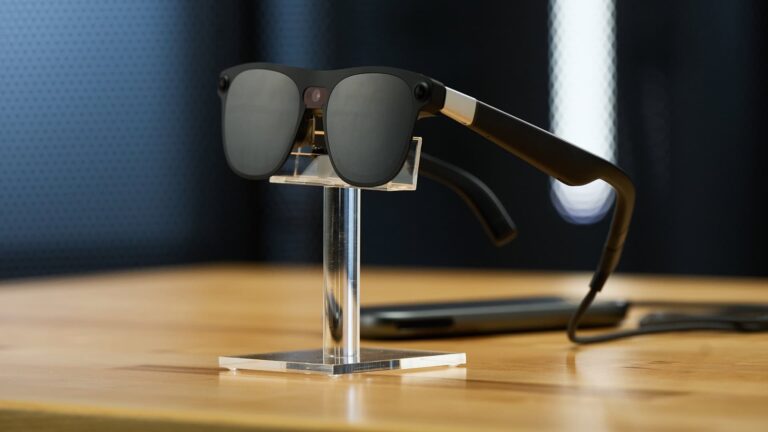
Welcome back to our weekly roundup of happenings from XR and AI realms. Let’s dive in…
The Lede
Xreal Aura Opens at $1,279 for Reservation Holders. Xreal announced that its Aura Android XR glasses start at $1,279 with 12GB of memory and 256GB of storage; a 16GB/512GB version costs $1,499. The optical see-through glasses weigh less than 95 grams and connect to a separate computing puck. Features include a 70-degree field of view, hand tracking, Gemini, Google Play apps, and Bose audio. Existing paid reservation holders in the United States, Canada, Japan, and South Korea can complete purchases. Xreal says broader ordering will open in the coming weeks, with initial shipments this year and additional markets in 2027. Here’s what I wrote in this column after I tried Aura at AWE in June, 2026, “I only had thirty minutes to play with them, but these are remarkably good, and that is remarkably bad news for Specs. If I could buy these tomorrow, I would.”
Feeling Spatial
Sony Transfers XR Patents To Meta. Sony has transferred U.S. patent properties to Meta, including technology related to virtual, augmented, and mixed reality headsets, according to reporting published Oct 7, 2026 by Road to VR, citing ZDNet Korea. Records show 43 U.S. patent properties transferred between June and September. A December 2025 agreement covers an expected 419 patents globally, including 180 U.S. patents. The portfolio includes head-mounted displays and information processing for XR applications, with filings dating from 2010 through 2022. Neither company had issued a statement on the transaction. The reporting does not establish a change to PlayStation VR2 support or availability.
Norway Proposes Restrictions On Camera-Equipped Smart Glasses. Norway’s government said it would pursue a temporary ban on smart glasses in selected public settings, citing the possibility of photographing, filming, or recording people without their knowledge. Potential locations include schools, healthcare facilities, and fitness centers with changing rooms. The proposed restrictions concern use in designated places and have not become law. Authorities also plan an expert group to examine longer-term regulation. The announcement follows scrutiny of camera glasses elsewhere in Europe, including Dutch retailers suspending sales. Meta says its glasses include recording indicators and safeguards against covering those lights.
Pimax Announces A $1,399 Wireless PC VR Headset. Pimax unveiled Crystal Pro alongside new controllers and its Spation compact VR computer. The headset costs $1,399, or $1,899 bundled with the company’s third-generation 60G Airlink system. Standard equipment includes a Wi-Fi dongle, external battery, and two controllers. It also supports a wired DisplayPort connection, which Pimax says runs the displays at 120Hz. The optional Airlink system uses two room antennas and eye tracking to transmit the area around the wearer’s gaze without image compression. Pimax’s FAQ lists demonstrations beginning in the fourth quarter and headset shipments starting in spring 2027.
XR Association Will Shut Down At Year’s End. The XR Association announced October 6 that it will close at the end of 2026. The trade group, whose members include Meta, Google, HTC Vive, and Qualcomm, said the decision followed discussions prompted by founding CEO Elizabeth Hyman’s retirement. Stephanie Montgomery will serve as interim CEO through the closure. XRA characterized the shutdown as completion of its mission, saying XR advocacy now belongs within broader technology policy discussions. Its remaining programs will continue through December. ITIF will continue its policy conference, BPC Action will carry forward legislative advocacy, and IVRHA will complete healthcare research and advance recommendations with interested partners.
Road To VR Marks Fifteen Years And 10,000 Articles. Congratulations to Ben Lang on another milestone. Road to VR marked its fifteenth anniversary with an interactive timeline of headset launches, industry events, and the publication’s own history. Founder Ben Lang started the site as a college student in October 2011, before the Oculus Kickstarter campaign. The retrospective charts annual article production alongside major milestones and each year’s most popular story, with monthly detail available by selecting individual years. Lang says the publication has produced more than 10,000 articles during that period. The timeline brings together reporting on the companies, products, and people involved in the modern XR industry.
The AI Desk
Google Introduces A Gemini Agent For Work. Google Cloud announced its Gemini agent, bringing questions, research, content creation, and code execution into a single work assistant. This follows the release of similar agentic features from OpenAI (Dot) and Meta (Muse). Google says the agent operates within Gmail, Drive, Docs, Slides, Sheets, Chat, and Calendar, carrying its memory, skills, and controls across applications. Teams can publish custom skills to a shared company registry, while individuals can create their own. The announcement also includes data analysis tools and specialized capabilities for financial services and legal teams. Google describes four types of memory covering active tasks, accumulated knowledge, learned procedures, and previous work, alongside administrative permissions and security controls. By the way, I just downloaded iOs 27 Apple Intelligence and can confirm it still has no intelligence.
Meta’s Muse Builds Dossiers On Users And Their Contacts. It’s a slow news week so I’m including a story that should surprise no one. From the department of “aren’t they already doing this,” Meta’s Muse assistant updates profiles of users and people mentioned in their messages and emails, according to TIME’s examination of its internal instructions. Updated hourly, the profiles record relationships, shared interests, disputes, and inferred goals. They can include people who do not use Muse. Meta told TIME that personal data is not shared with its advertising system and that users can ask the assistant to forget information. The company does use de-identified lessons to improve the service. TIME also found that asking Muse to forget something does not necessarily remove the original message containing it.
Cinematic Corner
AI Feature ‘Gods Don’t Give Gifts’ Plans A December Release And Oscar Campaign. Zack London, the YouTube creator known as Gossip Goblin, has released the trailer for his AI-generated feature Gods Don’t Give Gifts, opening in U.S. theaters December 4. Produced with Fable, the R-rated anthology follows four interconnected stories on Niiro Cradle, where bodies are disposable and consciousness is bought and sold. Humanity’s attempts to escape its physical limitations have horrifying consequences. Fable moved the release from October to December and plans screenings for Academy voters as part of a campaign for Best Animated Feature consideration.
Fox Nation’s AI Houdini Series Premieres October 14. Houdini: Back from the Dead, a three-part Red Rock Films docudrama, recreates the magician recounting his life in a modern documentary interview. Human writers developed the scripts, actors performed the characters, and AI altered their appearances using source material that included more than 400 licensed historical photographs. Producer Jordie Shapiro says the team repeatedly rebuilt footage as the tools improved, moving from Veo and Runway to Kling and Seedance. Fox calls it the platform’s first full-length, multi-episode production made entirely with AI-generated imagery. Dialogue draws on diaries, correspondence, books, and other historical records.
Tim Simmons Remakes ‘The Bridge’ With New AI Tools. Tim “Theoretically Media” Simmons, a guest in my first cinematic AI class in spring 2023, has remade his 2025 dark fantasy short The Bridge. The original used Veo 2. For the remake, Simmons used Seedance 2.5, GPT Image 2, and OpenAI’s Astra, generating footage through Runway’s MCP tool, editing in Adobe Premiere Pro, and finishing in DaVinci Resolve. Simmons says portions of the process required no keyboard input. He plans to explain the workflow in a forthcoming behind-the-scenes video on his free cinematic AI instruction channel.
Grindhouse Glitch Sends Wendy Into The Dreamworld. I just discovered Christopher Gwinn, the AI creator behind Grindhouse Glitch and Wendy’s Wonderful Dreamworld. In Episode 3, Wendy crosses the surreal landscape beyond a mansion to rescue her friend Kavi, imprisoned by his mother for bringing Wendy into the Dreamworld. The queen is determined to keep her from reaching the Black Rose Maze. Gwinn’s production combines images from Midjourney, Seedream, Nano Banana Pro, and GPT Images with Seedance and MiniMax H3 video. Seed Audio, ElevenLabs, Udio, and Suno supply music, sound effects, and voices.
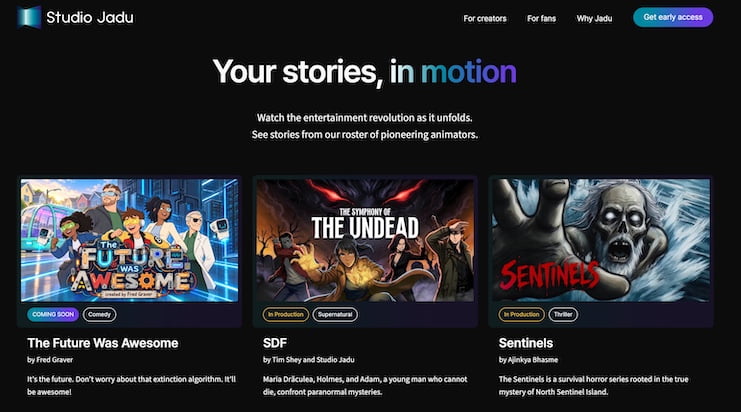
Studio Jadu Launches AI Animation Platform And Creator Program. Studio Jadu, founded by former YouTube and TikTok monetization executive Masoud Loghmani, has launched with backing from Khosla Ventures and Shakti VC. Its AIDA, or AI Director’s Assistant, turns scripts into animation under human direction. The company says independent creators retain creative control and share in revenue from their shows. Applications are open for its Pioneer Program, which targets anime-inspired creators and provides production, distribution, and monetization support. The studio’s business combines AI production tools with services for building audiences and earning revenue from original animated series.
Spatial Audio
This column has a companion, the AI/XR Podcast, hosted by its author, Charlie Fink; Ted Schilowitz, former studio executive and futurist for Paramount and Fox; and Rony Abovitz, founder of Magic Leap and Synthbee AI.
Our guest last week was mobile game designer Jonny Monsarrat (see episode below). Our guest this week is Charles Melcher, author of The Future of Storytelling: How Immersive Experiences are Transforming Our World.
Episodes drop on Fridays, and you can find them on podcasting platforms Spotify, iTunes, and YouTube.

Charlie Fink
AR Insider Contributor