
 by
by 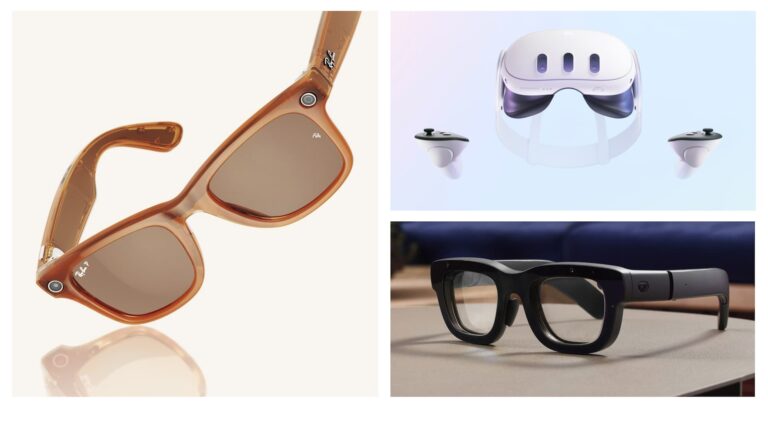
Meta announced Q2 earnings last week, including $60.8 billion in revenue, up 28 percent year-over-year. Growth continues to be driven by AI-fueled ad targeting. This is a powerful revenue driver, but it’s offset by Meta’s massive CapEx spending in building for an agentic future.
Resting under those high-level results, Meta Reality Labs’ (MRL) revenue was $431 million. This was up 16 percent year-over-year, and 7 percent quarter-over-quarter. But as it goes with MRL, the top-line party was crashed by massive bottom-line losses, to the tune of $4.6 billion in Q2.
Sticking with the top line, MRL growth was driven by Ray-Ban Meta Smartglasses (RMS), which doubled in year-over-year sales according to EssilorLuxottica’s Q2 earnings. The familiar earnings narrative is that smart glasses are the growth engine, while VR sales slow or decline.
There’s much to say about all these dynamics (more in a bit). But our main question is how Q2 revenue translates to hardware unit sales. This is an exercise we’ve done every quarter for several years (see last quarter), which helps inform broader VR momentum and market sizing.
Reverse Engineering
Diving in, MRL’s top-line revenue was $431 million in Q2, as noted. As done in the past, we can use this to reverse-engineer unit sales. This exercise gets harder every year due to more revenue sources. It’s not just one flagship Quest headset anymore… but several devices in the mix.
To that end, we’ve estimated Meta Reality Labs’ revenue share breakdowns based on several signals we’re tracking. You can see those estimates below. In this hardware-centric exercise, we’ll focus on the last 6 bullets, which account for 90 percent of MRL revenue.
- VR software (game & app sales): 9 percent*
- First-party accessories (head straps, etc): 1 percent
- Quest 3: 14 percent
- Quest 3s: 12 percent
- Meta Ray-Ban Display Glasses: 3 percent
- Ray-Ban Meta Smart Glasses: 47 percent
- Oakley Vanguard: 6 percent
- Oakley HSTN: 8 Percent
(percentages apply to revenue shares in dollars, not units)
*This figure represents the Oculus Store’s gross revenue, before developer payouts when applicable, which are usually 70 percent after taxes.
Per-Device Unit Sales
Quest 3
Based on the above revenue shares, Quest 3’s estimated quarterly revenue was $60.34 million. Considering an average unit price of $499, Meta sold an estimated 120,922 units during the quarter.
Quest 3s
Based on the above revenue shares, Quest 3s’ estimated quarterly revenue was $51.72 million. Considering an average unit price of $329, Meta sold an estimated 157,204 units during the quarter.
Meta Ray-Ban Display Glasses (MRD)
Based on the above revenue shares, MRD estimated quarterly revenue was $12.93 million. Considering an average unit price of $799 (and a revenue split with EssilorLuxottica), an estimated 21,586 units were sold during the quarter.
Ray-Ban Meta Smart Glasses (RMS)
Based on the above revenue shares, RMS estimated quarterly revenue was $202.6 million. Considering an average unit price of $329 (and a revenue split with EssilorLuxottica), an estimated 1,227,697 units were sold during the quarter.
Meta Glasses
Meta’s solo-branded smart glasses (sans EssilorLuxottica) were announced and demoed during the last week of Q2. The sales impact will be seen in Q3. We will include the device in next quarter’s calculations.
Oakley Vanguard
Based on the above revenue shares, Vanguard’s estimated quarterly revenue was $25.86 million. Considering an average unit price of $499 (and a revenue split with EssilorLuxottica), an estimated 103,440 units were sold during the quarter.
Oakley HSTN
Based on the above revenue shares, HSTN’s estimated quarterly revenue was $34.48 million. Considering an average unit price of $429 (and a revenue split with EssilorLuxottica), an estimated 160,372 units were sold during the quarter.
Grand Total
Adding up all devices, we get an estimated 1,791,221 units sold in Q2. That consists of 1,513,095 smart glasses and 278,125 VR headsets.
So there you have it. Of course, much of this exercise is based on the above-estimated revenue shares across Meta Reality Labs’ commercial products. Those share estimates are educated but up for debate: anyone can adjust them and calculate accordingly using the above model.
Owning the Stack
Stepping back, smart glasses are growing rapidly, but offset to a degree by declines (or flat growth in some quarters) for VR. That offset is impactful because of price tags: Unit sales fluctuations in VR headsets have a greater revenue impact than AI glasses due to higher unit value.
Altogether, the headline is that AI glasses are the growth engine, as noted. Meta will continue to internalize these demand signals and course-correct its road map accordingly. Today, that means non-display AI glasses (RMS) and, to a lesser extent, flat-AR display glasses (MRD).
This is Meta’s message to the market as MRL endures massive losses. The division remains massively in the red with $4.6 billion in Q2 losses, as noted. But due to MRL staff cuts and shifting priorities towards building an AI stack, it has projected MRL expenses to decline.
Wall Street seems to tolerate that narrative, as Meta shifts spending to massive CapEx investment in AI infrastructure. Though there’s skepticism on the street about such high CapEx among tech giants, there’s defensibility in owning the AI stack (Meta) versus outsourcing it (Apple).
Mark Zuckerberg learned this lesson the hard way throughout the smartphone era. By not owning or controlling the user touchpoint – ceding positioning to Apple and Google – Facebook suffered. MRL was created to own the XR stack, and the same approach is now in play for AI.
The bad news is that applying a full-stack development approach to two major product areas is costly. So MRL will continue to get budget pulled away for AI investment. But the good news is that headsets and wearables could eventually be the hardware layer of that full-stack AI puzzle.