
 by
by 
One health indicator in any tech sector is the venture funding that flows into it. XR is no exception, as its venture-funding fluctuations – both up and down – map to its general health. A historical sequence of XR industry ups and downs has tracked closely with its funding inflows.
These events over the past decade include the XR industry’s circa-2017 hype cycle, subsequent correction, quick rebound, metaverse boom/bust, Covid software boom/bust, and the more recent rise of AI. XR funding throughout this period maps closely to the macro-environment.
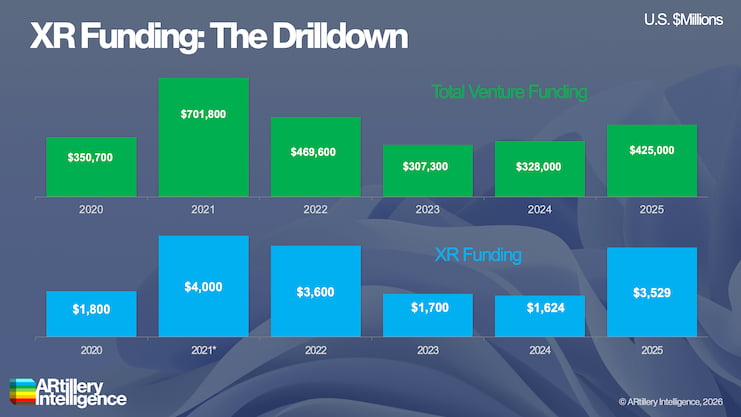
So where are we now? After a few years of declines – mostly due to the hangover from circa-2021 “metaverse mania,” XR venture funding reached $3.53 billion in 2025 – a 117 percent year-over-year jump. Meanwhile, 2026 year-to-date funding has mostly sustained this momentum.
What’s driving this growth? This is the topic of a recent report from our research arm, ARtillery Intelligence. It joins our excerpt series, continuing in this edition with XR’s correlations to venture investing. Does XR follow patterns of the broader tech funding landscape?
Mirror Image
Diving right into that last question, there’s a close resemblance between XR funding and broader tech investing. That includes year-over-year fluctuations in spending activity. Though it happens on a much smaller scale than aggregate tech funding, XR follows the same patterns.
In fact, comparing the two trendlines side by side reveals them to be mirror images. This supports our thesis that XR – though governed by many of its own native factors – is a subset or a representative microcosm of the dynamics that rule the broader venture funding universe.
Drawing out specific insights from the comparative trending (see the graphic below), both see a peak in 2021. This is driven by the Covid software boom in the broader tech investment universe; and the metaverse hype cycle in the XR realm. These were driven by similar macro factors.
Those frothy periods in both environments were then followed by a few years of declines as we saw a hangover to metaverse mania and the Covid software boom, respectively. Then, in 2025, both saw inflections which were driven in each case – but in different ways – by AI.
The key phrase in the previous paragraph is “in different ways.” AI is driving a great deal of tech funding to AI companies with defensible deep tech. It’s also driving investment in XR where it intersects with areas such as intelligent eyewear and the construction of world models.
K-Shaped Dynamics
But there’s a rather large caveat that comes with AI’s role as an investment accelerant. For companies outside of the AI tent – or those with loose integrations or non-proprietary tech – they’re largely left out of the funding blitz. AI is consuming all the oxygen (dollars) in the room.
For example, AI companies enjoy greater valuations, deal terms, and negotiating leverage than everyone else. Those that demonstrate strong proprietary tech, defensibility, and revenue growth see investors lining up to fund them. This endows a seller’s market for startup equity.
Meanwhile, non-AI companies are left with a smaller share of investment dollars that are now chasing AI. And those that do capture investor attention don’t get the negotiating leverage and glowing term sheets that AI companies do. There, it’s more of a buyer’s market for startup equity.
Most of the above K-shaped dynamics apply broadly across tech investing. But bringing it all back to XR, the strategic takeaway is to integrate XR wherever it is additive and natural. That includes user-facing ambient intelligence or developer-facing generative-XR capabilities.
But when doing that, it’s important to remember that AI associations and integrations have to be genuine and functionally sound. Simply speckling pitch decks with the word AI – a rampant practice during the metaverse boom – won’t work. Investors will see right through it.
We’ll pause there and pick things up in the next installment with more analysis around the XR funding environment, as well as segmentations like category, stage, and deal size. Meanwhile, check out the full report for more color.