


What Thirty Years of Place-Based Computing Taught Me About the Cyber-Physical Future
In 1996, I introduced Virtual Peninsula to Palo Alto and Silicon Valley with a simple proposition: digital technology should help people understand, participate in and care for the places where they live.
At the time, portable computers, head-mounted displays, three-dimensional graphics, telecommunications and the emerging Internet were converging into a new kind of infrastructure. We asked what might happen if that infrastructure were organized not around screens or platforms, but around people and place.
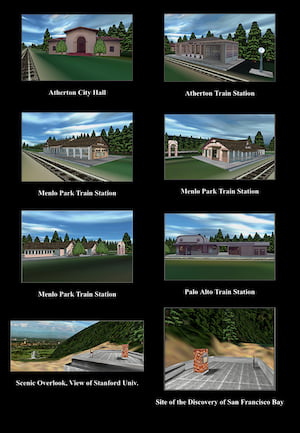
Virtual Peninsula connected three-dimensional environments, live video, avatars, businesses, public institutions, and natural environments within a digital representation of an actual community. We weren’t trying to create another world. We were extending this one—from the grassroots to the grasstops.
That central idea has become more consequential as spatial computing, edge computing, distributed networks and ambient artificial intelligence mature. Place-based computing can make buildings, streets, neighborhoods and watersheds computationally understandable while preserving their social, ecological and civic meaning. The goal is not to pull people out of their communities and into technology, but to use technology to deepen their ability to understand, navigate and shape those communities.
Thirty years later, here are seven truths I believe should inform what we build next.
1. The Interface Can Be the Place
Virtual Peninsula wasn’t fundamentally about virtual reality.
It was about Palo Alto.
The digital environment had meaning because it corresponded with a living community.
That distinction becomes profound as computing moves into the built and natural environment. A building, street, neighborhood or watershed can become computationally understandable without ceasing to be a real place.
The objective isn’t to pull people out of their communities and into technology.
It is to use technology to deepen their ability to understand, navigate, and participate in those communities.
2. Community Intelligence Came Before Artificial Intelligence
For most of human civilization, essential knowledge has lived within communities.
People knew the land, water, seasons, animals, paths, hazards, and one another.
Knowledge lived in elders, families, craftspeople, storytellers, healers, farmers, navigators, and relationships accumulated across generations.
Technology should not isolate people from that intelligence.
It should help communities carry it forward.
Artificial intelligence becomes far more interesting when it can complement human and community intelligence rather than substitute for it.
A spatial network should therefore ask not simply, “What does the machine know?”
It should ask, “What does this community know, and how can technology help its people understand and share that knowledge?”
3. Accessibility Can Be Infrastructure
My own path toward spatial computing began partly because my eyesight was failing.
Beginning in the late 1970s, my astrophysicist brother and I explored portable head-mounted electronic vision systems that might augment what I could perceive.
As blindness became part of my anticipated future, the question expanded beyond the device.
What if the community itself could become an assistive environment?
If location-based infrastructure could understand the built environment, it could help me understand where I was, what surrounded me and how places connected.
The same infrastructure could make everyone more capable.
Today I am totally blind, and that early insight seems more relevant than ever.
Spatial computing is not fundamentally visual computing.
It is computational understanding of relationships in space.
Once a place can communicate those relationships through images, language, spatial sound, touch, or haptics, accessibility becomes infrastructure rather than accommodation.
4. Community is Not Another Word for Users
A user has a relationship with a service.
A person has relationships with neighbors, family, institutions, culture, ecology, and place.
That distinction determines what technology optimizes.
A centralized platform can optimize attention, transactions, advertising, and engagement.
Community infrastructure can optimize participation, accessibility, resilience, knowledge, relationships, and quality of life.
The extraordinary growth of global platforms connected billions of people across enormous distances.
The next challenge is equally important: use technology to strengthen relationships among people and the places where their lives are actually lived.
5. Data Sovereignty Must Be Designed In
The cyber-physical continuum will generate extraordinary knowledge about human life.
Our movements.
Homes.
Relationships.
Infrastructure.
Energy.
Transportation.
Health of ecosystems.
Public spaces.
Community behavior.
Culture and memory.
We should not automatically surrender that information simply because a remote platform has the ability to collect it.
People should have meaningful sovereignty over information generated by their lives.
Communities should have meaningful stewardship over information generated by their places.
Process locally when practical.
Collect only what is useful.
Keep sensitive information close to its source.
Share outward when there is a legitimate reason to share.
Data sovereignty should not be a privacy setting buried inside a menu.
It should be part of the architecture.
6. Intelligence Should Live at the Appropriate Scale
Comprehensive anticipatory design science teaches us to look at whole systems and relationships.
The network I envision is therefore not simply centralized or decentralized.
It is distributed across appropriate scales.
Person.
Device.
Room.
Building.
Neighborhood.
Community.
Region.
Planet.
A device can solve some problems.
A building can solve others.
A neighborhood mesh can maintain local connectivity.
Community infrastructure can maintain spatial knowledge and digital twins.
Regional and planetary systems can coordinate what genuinely requires larger-scale cooperation.
Edge computing, mesh networks, advanced wireless systems and ambient AI increasingly make this architecture possible.
The cloud remains useful.
It simply doesn’t need to own the sky.
7. Build from the Grassroots to the Grasstops
This is where I believe spatial computing becomes a public infrastructure opportunity.
Imagine locally governed networks connecting people, buildings, environmental sensors, transportation, energy, water, public spaces, and civic resources.
Community-controlled digital twins provide living representations of place.
Edge intelligence handles appropriate information locally.
Open spatial standards allow environments to communicate.
Mesh networks provide resilience.
Emerging 6G hub networks connect communities outward.
Ambient intelligence makes complicated systems understandable without requiring everyone to become a specialist.
And open public networks connect communities regionally and globally without requiring local knowledge, identity and data to be surrendered to a centralized gatekeeper.
I call the larger framework the Macrocommons: extending the enduring principles of the commons into the technological, ecological and infrastructural systems upon which contemporary life depends.
The architecture can be planetary without becoming monolithic.
Local knowledge can remain local while participating in larger intelligence.
Community sovereignty and global cooperation are not opposites.
Properly designed, each strengthens the other.
Thirty Years Forward
The thirtieth anniversary of Virtual Peninsula is not simply an occasion for me to look backward.
It is an opportunity to continue the experiment with capabilities we could only anticipate thirty years ago.
Through Fullervision Design Science and my work as Planetary Coordinator for Future Communities with the X Art Planetary Arts Society, I am exploring how artists, technologists, standards organizations, universities, young people, elders and communities can participate in creating this next generation of place-based spatial networks.
The most important intelligence in these networks will not necessarily be artificial.
It may be the intelligence humanity has always possessed when people know one another, understand where they live, remember what came before them and accept responsibility for what comes next.
Technology can help make that intelligence visible, accessible and actionable.
The cyber-physical continuum should not become another place where communities become the product.
It should become infrastructure through which communities become more capable of determining their own future.
Thirty years ago, Virtual Peninsula began with people and place.
Thirty years forward, I believe we should begin there again.
Build intelligence into the fabric of life.
Keep agency and data sovereignty in the hands of people and communities.
Connect places openly.
And build the network from the grassroots to the grasstops.

Gordon Fuller
AR Insider Guest Author