
 by
Immersive marketing continues to be an opportune, yet still challenged, segment. Sitting at the intersection of brand marketing and spatial computing, it includes things like sponsored AR lenses that let consumers interact and engage with brands, or virtually try on products.
Driving immersive marketing are a few key elements. Lens creation software arms brands and developers with low-code tools to author AR experiences. Meanwhile, networks like Snapchat and TikTok likewise offer the ability to amplify lenses throughout their social graphs.
There’s also a real business case, which can be seen in the performance metrics around AR campaigns. And though the future of AR is headworn, we’re mostly talking about AR marketing on smartphones. That’s where the scale lies… and brand marketers are all about scale.
This is the topic of a recent report from our research arm, ARtillery Intelligence, including ecosystem analysis and case studies from real AR marketing campaigns. The report joins our excerpt series, continuing in this edition with a look at Huggies’ Immersive ad campaign.
Brand Building
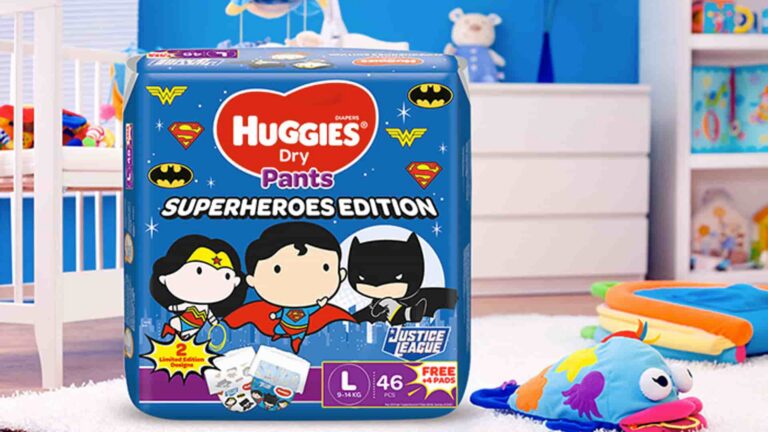
Diapers are a product category that’s reached commodity status. So, growing and protecting market share is all about brand building and promotions. In that light, Huggies limited-edition Justice League superhero diapers were launched to make the brand stand out on store shelves.
To double down, Huggies decided to couple the release with an immersive marketing component. It partnered with 8th Wall (now open source) and Xtendr on an AR filter that played on the Justice League theme, as well as the common pastime of capturing and sharing baby pictures.
Specifically, the face filter let parents transform their babies into Justice League superheroes such as Superman, Batman, and Wonder Woman. A call to action was included at the end of the experience to “buy now” and order the product, or share images and videos on social media.
As for getting the lens out there, Huggies decided to cast the widest net and reach the largest possible audience by choosing a web AR campaign. Users discovered and activated the experience by scanning a QR code on diaper packs and other print & digital promotions.
For additional viral distribution and user engagement, users were encouraged to share the photos on social media using the hashtag #HuggiesJusticeLeague. They were further incentivized to participate with a prize giveaway, randomly selected among social posts containing the hashtag.
Costumed Adornment
And the results? The Huggies Justice League AR campaign achieved an 85 percent engagement rate and 400,000 total engagements. Beyond sheer reach, it also demonstrated a depth of engagement with a 41-second average dwell time, as well as 27,000 repeat users.
As for strategic takeaways, this campaign worked partly because it tapped into the characteristics of the brand in playful ways, allowing users to pose as their favorite superhero. But rather than doing so in a selfie format – as it often goes – Huggies utilized the rear-facing lens.
This was deliberately done to capture the costumed adornment of someone else. That someone else happened to be the user’s child or relative. As such, the campaign tapped into parents’ natural desire to photograph their children in fun or whimsical ways and to share the result.
This essentially gave parents a free, costume-equipped photo studio. Meanwhile, the Huggies brand was taken along for the ride in terms of benefiting from goodwill among parents and additional visibility and impressions from the captured media that they share on social media.
We’ll pause there and circle back in the next installment of this series with another campaign case study. Meanwhile, check out the full report.