


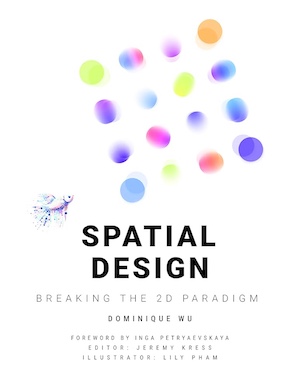
Spatial Design, Breaking the 2D Paradigm, a new book by Dominique Kun-Yu Wu, is a thoughtful and well-structured contribution to the scant literature around spatial computing, XR, and immersive experience design. Wu says spatial design is a practical extension of existing design practices, grounded in history, human behavior, and real production constraints.
Wu takes a field that is often fragmented across disciplines and platforms and presents it as a coherent design practice with shared principles. Early chapters situate spatial design within a broader technological arc, tracing the progression from early VR experiments to contemporary mixed reality systems. This historical grounding gives readers useful context for understanding why spatial design problems look the way they do today, particularly as AI, computer vision, and real-time rendering converge.
Wu repeatedly returns to questions of perception, comfort, attention, and agency. Discussions of presence, embodiment, and interaction are framed in practical terms that designers can apply whether they are working in VR, AR, MR, or hybrid environments. The sections addressing comfort, safety, and cognitive load are particularly strong, emphasizing that successful spatial experiences depend as much on what designers choose to exclude as what they include.
The book also benefits from its synthesis of multiple design traditions. Wu draws clear connections between graphic design, UX, industrial design, architecture, and game design, showing how each contributes to spatial work. The book treats spatial design as an integrative layer that requires designers to broaden their skill sets. In the chapter on the designer’s evolving role, Wu describes a shift from narrow specialization toward more generalist thinking informed by systems awareness and collaboration.
The ten spatial design principles form the structural core of the book. These principles are presented not as rigid rules but as patterns that recur across successful immersive experiences. Concepts such as engagement, context, control, personalization, and evaluation are illustrated through concrete examples and diagrams that clarify how abstract ideas translate into design decisions. The visual explanations are especially helpful in showing spatial relationships and interaction flows that are difficult to convey through text alone.
Wu’s treatment of AI is measured and pragmatic. AI is presented as an enabling layer within spatial systems rather than as an end in itself. The discussion focuses on how AI supports perception, adaptation, and responsiveness, particularly through spatial artificial intelligence that interprets environments, users, and intent in real time. This framing avoids exaggeration while still acknowledging the growing importance of AI-driven systems in immersive design.
The book is clearly written with practitioners and students in mind. It avoids excessive jargon and defines terms carefully, making it accessible to readers who may be new to XR while still offering depth for experienced designers. The inclusion of industry voices and real-world projects reinforces the book’s applied focus and helps bridge the gap between theory and practice.
Overall, Spatial Design, Breaking the 2D Paradigm succeeds as both an introduction and a reference. It offers a shared vocabulary and a set of grounded principles that help designers think more clearly about space, interaction, and human experience. As spatial computing continues to move from experimental deployments into everyday contexts, this book provides a useful foundation for anyone working at that intersection.
Spatial Design, Breaking the 2D Paradigm is a clear, practical guide to spatial computing and XR design, covering immersive principles, AI, AR, VR, and the future of human-centered experience design.
Header image credit: Pickawood on Unsplash
 Charlie Fink is the author of the AR-enabled books “Metaverse,” (2017) and “Convergence” (2019). In the early 90s, Fink was EVP & COO of VR pioneer Virtual World Entertainment. He teaches at Chapman University in Orange, CA.