
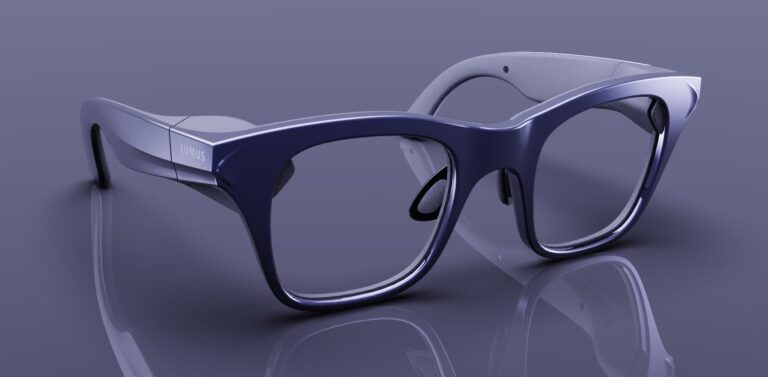

2025 marked a turning point for AR glasses. For the first time, a mainstream consumer product shipped with a near-eye display that was powerful, manufacturable, discreet, and socially acceptable in everyday life. The Meta Ray-Ban Display glasses showed the industry that AR can resemble eyewear people already wear. Just as important, they demonstrated that display-level privacy is achievable in a commercial product.
Geometric waveguides proved themselves a privacy enabler in 2025 – which matters even more as consumer AR adoption grows.
The fact that an AR display could remain completely private for the wearer – no glow, no leakage, no outward signal of activity – set a new bar for the category. And it wasn’t accidental. It was the result of an optical architecture that has become one of the most reliable foundations for consumer AR: geometric waveguides.
As AR glasses diversify into more form factors and fields of view, the expectation established in 2025 will only grow stronger. The optical system will carry more information, sometimes at higher brightness, across larger surfaces – and the privacy requirement that held true for early devices must hold true for the next generation as well. That continuity is exactly why geometric waveguides matter – because without dependable display privacy, the category simply cannot scale.
Privacy Has Always Been a Requirement – 2025 Proved It Can Scale
Privacy isn’t a new concern for AR. Early prototypes faced social pushback when displays leaked faint halos or telegraphed content through the lens. That ambiguity created discomfort on both sides – wearers felt exposed, and people around them weren’t sure what the device was showing.
The difference in 2025 was that a commercially shipped device solved this at scale. With a monocular display featuring Lumus’ geometric waveguides, Meta’s Ray-Ban Display lined up with normal social expectations: people couldn’t see what was being shown, and the wearer didn’t broadcast their activity.
That wasn’t a coincidental result of form factor; it was the outcome of the optical design itself. It demonstrated that privacy is a solvable engineering constraint that must be met from the start.
Why Geometric Waveguides Solve the Privacy Issue
As display responsibility shifts from narrow notification surfaces to broader contextual content, the optical system becomes the first – and sometimes only – line of defense for privacy. Geometric waveguides address the problem at its core in a few ways that matter at scale:
- Directional delivery – Light is guided toward the wearer’s eye rather than leaking outward, keeping the image bright for the user but invisible to others.
- Contained imagery – The display does not produce the ghost images or faint halos that early AR glasses revealed to bystanders.
- Discreet visibility – Even in daylight or crowded environments, the image stays private, allowing users to glance at information without broadcasting it.
- Natural social presence – Because the image is fully contained within the lens, people nearby see only the wearer’s eyes, not a screen, keeping interactions comfortable and familiar.
As AR Use Cases Expand, Privacy Remains Critical for Mass Adoption
The industry is beginning to move toward thinner form factors and more immersive visual layers. Each progression increases the amount of information displayed and the surface area where leakage could occur.
But the privacy expectation set in 2025 will not change. What the user sees must remain visible only to the user. Whether a device is monocular or binocular, narrow or wide, used for quick glances or deeper contextual overlays, no one else should see what the wearer sees. The geometric waveguide architecture – not settings, not UX, not user vigilance – is a critical gatekeeper of privacy.
AR glasses will continue moving into environments where social expectations are consistent: offices, transit systems, meeting rooms, classrooms, shops, and public spaces. In all of those settings, personal information is expected to stay personal. Constant visible leakage undermines that expectation.
A private display removes uncertainty for bystanders and gives wearers the confidence to use AR in situations where attention and discretion matter. This is essential for a device intended to be worn throughout the day, not just in controlled scenarios like the home.
Where the Category Goes from Here
As AR glasses move beyond the 2025 inflection point, the industry will see a wider range of device form factors. Some will prioritize maximum field of view; others will prioritize minimal thickness or aesthetic neutrality. But none of those advancements matter if people feel exposed wearing the device, or if bystanders feel uneasy around it.
A display has to do more than be sharp or bright; it has to feel contained, natural, and personal, offering information the way people already expect from the devices they rely on today. Without that sense of discretion, the rest of the system will struggle to find its footing.
As AR scales, the products that succeed will be the ones that deliver more capability without expanding their footprint in the world around the wearer. Geometric waveguides have already shown that this balance is possible – and that respecting the boundary between public and personal experience is the path from early adoption to everyday use.
 David Andrew Goldman is VP at Lumus.