


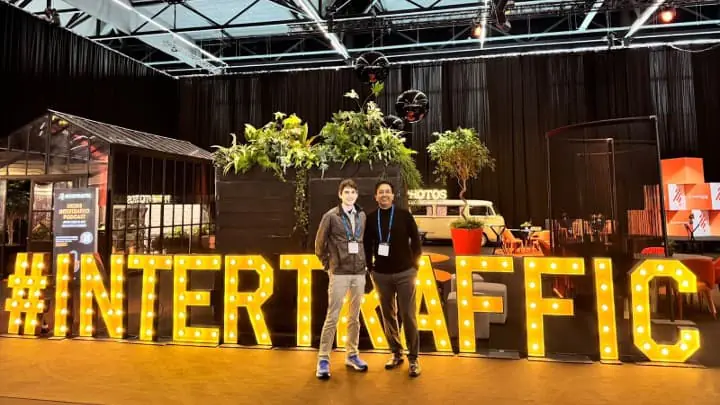
Intertraffic Amsterdam 2026 drew global leaders in traffic technology, mobility infrastructure, and urban systems, and the agenda in the meeting rooms was far more specific than the event’s broad stage suggests.
Attending organizations included Q-Free, SWARCO, Kistler Group, Quarterhill, Arrive, Haskoning, and Arcadis across a focused series of discussions. The throughline across all of them: infrastructure operators are no longer evaluating whether to adopt geospatial digital twins and scenario simulation. They are evaluating how and who gets them there.
Inside the Conversations: What Operators Actually Need
Across every meaningful exchange at Intertraffic, the discussion was grounded in operational reality, not platform vision. Dominant themes included:
- Traffic signal timing optimization across live networks
- Ambulance and emergency vehicle priority routing
- Lane closure impact and diversion planning
- Peak-hour congestion management
- Toll pricing impact analysis
- Flood and weather emergency response coordination
These are not pilot project ambitions. These are daily decisions being made today, often without the data integration, simulation capability, or spatial context to make them confidently.
What operators consistently described was a single underlying need: bring multiple data sources together, run scenarios against them, and surface the results in a way that every decision maker in the room can act on.
Rethinking the Digital Twin: From Concept to Decision Layer
The term “digital twin” has carried a lot of weight in the infrastructure industry, and at Intertraffic, it was clear that weight has shifted.
The interest is no longer in digital twins as visualization showcases. It is in digital twins as active decision infrastructure, environments where traffic flow data, signal timing inputs, sensor feeds, and structural data can be combined, queried, and tested against scenarios in real time.
SuperDNA 3D Lab demonstrated exactly this: a platform architecture that ingests multiple heterogeneous data sources, builds a unified operational environment, and layers scenario simulation on top, all rendered within a geospatial context that reflects the actual city.
The distinction matters. A digital twin that shows you the city is useful. One that lets you ask, ‘what happens if,’ and shows you the answer spatially, is, ‘what operators are now asking for.’
Geospatial Visualization as a Decision Multiplier
One of the clearest points of alignment across Intertraffic discussions: geospatial visualization doesn’t just improve analysis. It changes who can participate in a decision.
When scenario outputs are rendered in a three-dimensional city environment, the audience for that analysis expands well beyond technical teams. Infrastructure directors, city planners, emergency services coordinators, and policy stakeholders can all engage directly with the output, because the city itself provides the context.
Which corridor is affected? Which intersections approach capacity. Which districts face the greatest impact? These become immediately visible, not inferred from a data table.
For SuperDNA 3D Lab, this is a core design principle: geospatial context is not a presentation layer. It is the decision layer.
From One-Off Simulations to Continuous Scenario Infrastructure
A recurring tension surfaced at Intertraffic: the gap between what simulation can do and how it is currently used.
Most agencies run scenario analysis episodically, a study commissioned for a specific decision, delivered, and rarely revisited. But the conditions those decisions were built on change constantly. Traffic volumes shift. Infrastructure ages. Climate inputs evolve. A simulation frozen at the point of delivery loses relevance fast.
What operators described at Intertraffic was a need to own scenario capability rather than consume it. A persistent environment where inputs can be updated, models swapped, and scenarios re-run as conditions change without rebuilding the analytical pipeline from scratch each time.
This is the shift SuperDNA 3D Lab is designed to enable: scenario simulation not as a study, but as standing infrastructure that evolves with the city it represents.
What-If Modeling: The Questions That Drove the Room
The most energized conversations at Intertraffic centered on what-if scenario modeling at the operational level:
- If a green phase is extended by ten seconds on a key arterial, how does flow change downstream?
- If an ambulance requires priority access through a congested corridor, which signal adjustments minimize network-wide delay?
- If peak-hour volume increases unexpectedly, which intersections hit capacity first and in what sequence?
These are not hypothetical research questions. They are the decisions traffic operations centers face in real time, and the demand is for simulation environments fast and integrated enough to support them as they happen, not in retrospect.
The End of One-Off Studies: Continuous Scenario Simulation for Cities
Data Security: A Non-Negotiable in Every Room
Across discussions with municipal agencies and infrastructure operators, one requirement appeared without exception: data cannot leave the client’s environment.
For organizations managing sensitive operational infrastructure, this is a procurement threshold, not a preference. Platforms that require data to be routed through external systems face real compliance barriers in this sector.
SuperDNA 3D Lab’s architecture is built around this requirement, operating within the client’s own environment, with encrypted data handling and access controls designed from the ground up.
The Signal From Amsterdam
Intertraffic Amsterdam 2026 made one thing clear: the infrastructure industry has moved past the question of whether geospatial digital twins and scenario simulation belong in operational decision making. That question is settled.
The conversations now are about implementation, about platforms that integrate real data, run credible scenarios, visualize outcomes spatially, and keep sensitive information secure.
SuperDNA 3D Lab is built for precisely that intersection. Amsterdam confirmed the demand is there. The work is in delivering it.
Header image credit: Laurie Decroux on Unsplash

Jatinder Kukreja is founder & CEO of SuperDNA 3D Lab.