
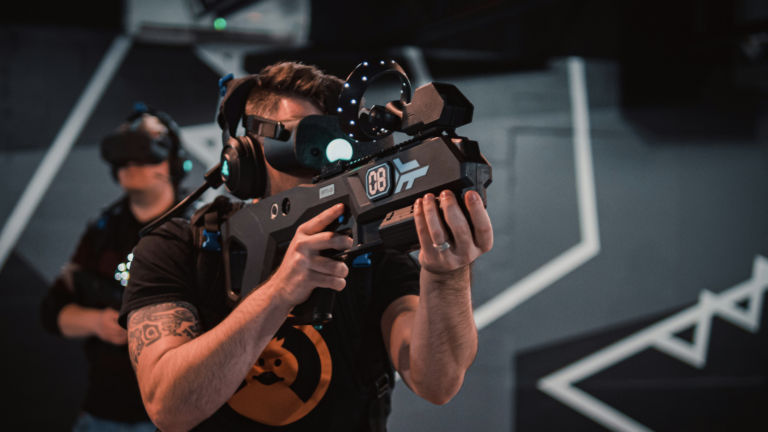

Last month, I took a group of students from my emerging media class at Chapman University to Sandbox VR at the Cerritos mall, here in southern California. We chose Squid Game Virtuals, a multiplayer VR experience based on the Netflix series.
Squid Game Virtuals was being offered along with Sandbox VR’s other titles, notably one based on another Netflix property, Stranger Things: Catalyst, and the company’s own Deadwood. We made the right choice. The six mini-games inside Squid Game Virtuals are well-designed and intuitive cooperative strategy games and competitions. It is hard to organize six people in remote locations in home VR, but it’s a natural in a location-based experience, and that’s part of the fun.
Wearing headsets, haptic vests, and motion trackers, we entered a large empty room to be outfitted with headsets. This is a “warehouse scale VR” digital arena where we could see and interact with each other’s avatars as we competed through the show’s familiar challenges.
Everyone had fun. We laughed, shouted instructions, and compared scores afterward. But when the session ended, and we discussed it as a group, the reaction was revealing. At $50 per ticket for the premium experience, none of the college students said they planned to return soon or bring friends, unless someone else was footing the bill.
That tension between novelty and repeat value has defined location-based VR for decades. Several early players in the category collapsed under the weight of expensive builds and ambitious storytelling. The Void, once the most visible company in the space, closed after the pandemic despite partnerships with Disney and Sony. Dreamscape, another heavily funded immersive entertainment venture in partnership with AMC, also struggled.
Yet two companies have quietly endured and grown: Zero Latency and Sandbox VR. Both appear to have reached the scale the business requires. Sandbox VR now operates more than 80 locations worldwide, serving about 150,000 players per month and surpassing five million lifetime guests. The company says its venues have generated roughly $300 million in lifetime ticket sales.
“We are celebrating our 10th anniversary this year as a company,” Sandbox VR founder and CEO Steve Zhao said in an interview. “Having started out with only one location to now having built out a robust in-house, fully vertical system through a combination of franchise operations, tech innovation, content development, and marketing is pretty incredible.”
Scale matters because content is expensive. Multiplayer VR experiences require ongoing development, new scenarios, and periodic technical upgrades. Without enough locations to spread those costs, operators struggle to maintain a steady pipeline of new experiences.
“Content is the flywheel for growth,” Zhao said. “More locations allow for more investment into content, which in turn drives more demand, resulting in more locations.”
Industry consultant Bob Cooney, a longtime advisor in location-based entertainment, says Sandbox VR’s approach reflects a model that finally aligns technology, content, and venue economics. Writing recently about the company’s expansion, Cooney described the network as a kind of “downloadable theme park,” where new experiences can be distributed digitally across a growing set of venues.
The franchise model also shifts some of the capital burden to operators. Cooney notes that opening a Sandbox VR location can approach $1 million in upfront investment, making utilization and demand critical to success.
Sandbox VR’s catalog combines original titles with licensed franchises. The company’s Squid Game Virtuals experience, launched in 2023, has generated more than $50 million in ticket sales. Other titles draw from Netflix properties such as Stranger Things, alongside original experiences like Deadwood.
“Premium IPs help us drive awareness through the momentum of that IP,” Zhao said. “For example, we timed the launch of our Squid Game experience ahead of the reality show.”
Despite the novelty factor, the company says many guests return. Zhao estimates that roughly one-third of Sandbox VR customers are repeat visitors. He argues that the category thrives precisely because it offers something home VR strives to replicate: shared physical presence. “There’s a fundamental need for people to spend time together in person,” Zhao said. “Location-based VR transforms passive screen time into group adventures.”
Consumer VR adoption has been uneven. According to Counterpoint Research, global VR headset shipments declined 12 percent in 2024. Zhao interprets that trend as evidence that VR may resonate more strongly in social settings than in solo home use. “At home, VR has had a hard time overcoming gaming and productivity,” he said. “Our solution is to be a top choice for out-of-home, community-based social experiences.”
Sandbox plans to continue expanding through its hybrid model of corporate and franchised locations. The company is rolling out 25 new venues across the Middle East with franchise partner Apparel Group, alongside new locations in Canada and Europe. The company’s newest Age of Dinosaurs experience will launch globally on April 3rd.
 Charlie Fink is the author of the AR-enabled books “Metaverse,” (2017) and “Convergence” (2019). In the early 90s, Fink was EVP & COO of VR pioneer Virtual World Entertainment. He teaches at Chapman University in Orange, CA.