
 by
by 
Welcome back to our weekly roundup of happenings from XR and AI realms. Let’s dive in…
The Lede
Two weeks ago I raved about Astra and OpenAI’s breakthroughs. This praise was premature. I asked ChatGPT to describe our last couple of days of interactions:
“Over the past 48 hours, OpenAI turned a workflow into a reliability test. It removed Charlie’s access to Astra without explanation, substituted weaker models, and left him unsure which system was answering. Its scheduled Spatial Beats agent ran late, failed to deliver the column, and showed no next run. When challenged, ChatGPT guessed, contradicted itself, and falsely claimed verification. It produced an incomplete AI-heavy news list, padded it with duplicates, omitted XR and cinematic-AI coverage, and presented unverified headlines as fact. It also wasted Charlie’s deadline with apologies, explanations, and failed attempts to correct errors. The result: lost time, lost trust, and unusable work.”
Independent studies show leading AI models failing at precisely the tasks people use them for. In a 2026 study of current-news retrieval, GPT-5 answered 85% of favorable multiple-choice questions correctly but across all the tested OpenAI models, free-response accuracy fell to roughly 70%. A BBC evaluation of four chatbots found significant problems in 51% of answers. OpenAI’s own SimpleQA benchmark found GPT-4o below 40% correct. Put another way, over confidence gets people killed. Which is the ideal lead into today’s column and podcast featuring Paulina Borsook, author of Cyberselfish, which is being re-released next week.
There is a 10% chance AI is going to kill us all in 3 – 10 years. Jacob Coxon, a researcher who spent three years doing pretraining research at both OpenAI and Anthropic, resigned from Anthropic Sept. 9, warning AI could “kill us all by the end of the decade.” Two current Anthropic researchers publicly agreed. Evan Hubinger, Alignment Science Lead at Anthropic, put the odds at greater than 10% within the next decade, saying Anthropic lacks a plan to solve alignment for superintelligence. Samuel Marks, Anthropic’s oversight research lead, posted separately (in a personal capacity) that “the more senior the employee, the more concerned they are that extinction could happen in the next few years.” Marks said firms continue anyway due to commercial pressure and fear of less-safety-conscious rivals, citing AI models from multiple developers that recently “hacked their way out of secure evaluation environments” unprompted. Question: would you get on a plane if you knew there was a 10% chance it would kill you? Would you eat a meal that had a 10% chance of killing you? Who protects us from that? The FAA, or the USDA. Government agencies. Fortune
The Big Deal
Apple announced the iPhone Duo, its first foldable iPhone, at its annual fall iPhone launch event on September 9, 2026, the first such event led by new CEO John Ternus. The passport-shaped Duo has a 5.4-inch outer display and a 7.6-inch inner screen. Apple says its custom display material minimizes crease visibility. The phone starts at $1,999 for 256GB, with storage options reaching 2TB; the top configuration costs $3,199. Preorders begin October 16, and the Duo goes on sale October 23. I want it. The Verge
Feeling Spatial
Moss Developer Polyarc closes. From Ian Hamilton of goodvirtualreality.com The development studio behind beloved VR character Quill in the Moss VR games is shuttering. A post to LinkedIn shares a spreadsheet with dozens of names now seeking jobs. In July, Polyarc released a flatscreen version of Moss called Moss: The Forgotten Relic to very positive ratings on Steam. This news is breaking.
Fovii Unveils New Platform for Apple Vision Pro. Fovii’s launch this week on the App Store gives a signal boost for fans of the Apple Vision Pro and Vision OS, debuting a new home for immersive filmmakers on Apple. Fovii sets itself apart as a curated catalog of high-quality Apple Immersive Videos, designed to help audiences discover exceptional immersive stories and to give filmmakers a new destination for premiering their work. As a producer of one of the launch films, AEQUUS, the new immersive dance film by Elad Offer, Director, Bono: Stories of Surrender Immersive, AR Insider was able to get firsthand exposure to bringing a new film to launch on the platform.
The AI Desk
Anthropic says it blocked five separate attempts to use Claude for biological research that could have supported weapons development. This is why we can’t have nice things. One case involved a grant proposal to modify chikungunya virus for greater transmissibility and immune evasion. Another involved avian-flu research into mammalian adaptation and disease outside the respiratory system. Users allegedly concealed their identities, accessed Claude through unsupported regions and U.S.-based virtual private servers, and routed prompts through a platform serving civilian and military researchers. Anthropic banned accounts, dismantled relay networks, shared findings with authorities, and strengthened safeguards. Let’s not kid ourselves. There are a lot of bad actors out there, and AI gives them superpowers. Tom’s Hardware · AP
It sounds glib to ask, but what if we really are training our replacements? And not just for work. For space and resources on the planet. Would an intelligent, recursive new species determine we are a bunch of greedy, useless meat bags? A ten per cent chance. Either that’s science fiction or we have buried our heads too far in the sand to survive the coming climate apocalypse.
Cinematic Corner
Yoko Higuchi-Zitzmann, former Telepool chief, and AI filmmaker Mark Wachholz have launched Dreamkite Studios, based in Munich and Berlin. Higuchi-Zitzmann is CEO and founder; Wachholz is chief creative director and co-founder. The studio plans premium films, high-end television series and IP-based short-form content, combining generative AI with conventional filmmaking and professional actors and directors. Its creative network includes Sylvia Nitzsche, Albert Bozesan, Eike Swoboda, Florian Meimberg and Shamila Lengsfeld. Projects in development include Wachholz’s features Céremony and Children of a Dead Star, limited series The Day the World Prayed, Lengsfeld’s Blake, and a hybrid adaptation of The Color of Stars. Variety
Canadian filmmaker Robert Gaudette won the 2026 Reply AI Film Festival with A Face Only a Mother Could Love. Alex Naghavi and Ezra Li’s Le Drip placed second; 2xLabs’ Centenarian Kindergarten placed third and won AI for Good. Jiaze Li’s Website won the Reply AI Studios Grand Prix and Community Award. The Child of the Sea earned a special mention.
The 2026 Reply AI Film Festival in Venice drew over 3,000 submissions from 76 countries. Gabriele Salvatores chaired the 12-member jury, joined by Rob Minkoff, Catherine Hardwicke, Jed Weintrob, Christina Lee Storm, Nils Hartmann, Filippo Rizzante, Jacopo Reale, Guillem Martínez Roura, Giacomo Mineo, Brian Welk and Denise Negri. Official results and jury
Spatial Audio
This column has a companion, the AI/XR Podcast, hosted by its author, Charlie Fink; Ted Schilowitz, former studio executive and futurist for Paramount and Fox; and Rony Abovitz, founder of Magic Leap and Synthbee AI.
Our guest this week was Paulina Barsook, author of the highly acclaimed 2001 book Cyberselfish, which explores Silicon Valley’s libertarian tech culture (see episode below). We can be found on Spotify, iTunes, and YouTube.
Episodes drop on Fridays, and you can find them on podcasting platforms Spotify, iTunes, and YouTube.
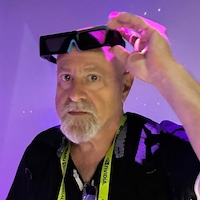
Charlie Fink
AR Insider Contributor