
 by
by 
Viture announced today that it’s expanding into a new device category. Erstwhile specializing in entertainment-centric video display glasses, today’s move brings it into intelligent eyewear. Known as VONDER, its new line of AI glasses prioritizes subtle and ambient AI interactions.
Before getting into device specs and strategy, let’s back up for context. VITURE’s primary category is video display glasses, as noted. These are popular for mirroring content from USB-C devices – offering virtual private massive-screen displays for movies, gaming, and productivity.
As for the device class they’re moving into with VONDER, AI glasses don’t offer a visual UX, but instead rely on audible AI and situational intelligence. The goal is ambient and intelligent assistance whose utility and personal relevance – thanks to AI – make up for a lack of visuals.
This category has been pioneered by Ray-Ban Meta Smartglasses, selling 15 million+ lifetime units according to our research arm, ARtillery Intelligence. They have validated a market and attracted several other players and approaches, including Samsung and Apple (rumored).
Personal Memory Graph
With that contextual backdrop, what is VONDER and what does it offer? Positioned as “privacy-first intelligent eyewear,” there’s no camera and no display. It ingests information about a user’s lifestyle and surroundings to offer intelligent assistance through audible response.
This is all driven by what VITURE calls a Personal Memory Graph. Trained on a user’s notes, conversations and situational context, it surfaces patterns and information from one’s life interactions. For example, it can summarize a meeting or recall an address.
It can also be connected with leading models such as ChatGPT, Claude, and Gemini, as well as VONDER AI that combines multiple models. Beyond AI functions, VONDER offers standard assistant utilities such as voice notes, reminders, hands-free music, and making calls.
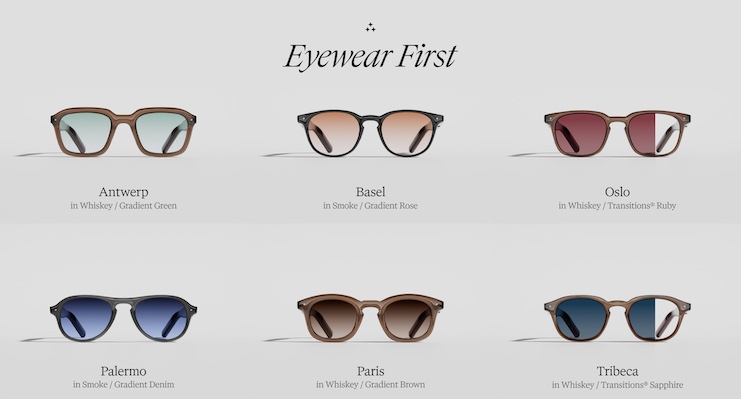
As for the hardware, VONDER comes in several variations from six frame shapes and three colors. It has an acetate construction and weighs less than 30 grams. It also offers full prescription compatibility, as well as Transitions and gradient tint lenses for indoor/outdoor use.
Altogether, this expands VITURE’s addressable market. After carving out a leading position in video display glasses, it expands into AI glasses. Here, it’s smart to launch a separate brand, as a style-first persona should stand on its own without being confused with VITURE’s primary play.
Design Philosophy
VONDER can be further contextualized by its DNA. The endeavor is largely inspired and executed by Viture’s “new Co-Founder,” Guillaume Hamon (pictured above). Bringing experience from Rivian and Oura, his creative signature includes VONDER’s design and fashion-first approach.
Guillaume’s design philosophy asserts that the best technology should disappear. This is especially the case with smart glasses that intersect with fashion. Much of this comes down to the design sequence – starting with fashionable eyewear, then adding intelligent functions.
VONDER also seeks to find the right balance of tech and eyewear. In other words, how prominent versus muted should the UX be? VONDER leans towards a subtle presence, with AI that quietly understands users, then activates sparingly when relevant or called upon.
Viture has been working on VONDER for almost two years. That will pay off when pre-orders begin on September 28 for $299, online and at Best Buy – building on Viture’s existing retail presence. We’ll see what this does for the momentous but crowded AI glasses landscape.