
 by
by 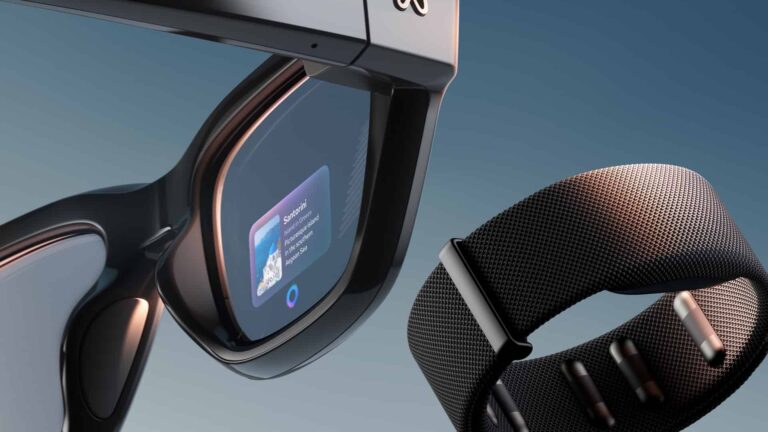
As we roll into 2026, it’s time for our annual ritual of synthesizing the lessons from the past twelve months and formulating the outlook for the next twelve. 2025 was an action-packed year for spatial computing, which continues a gradual uphill ascent toward mainstream traction.
2025 highlights include XR’s ongoing convergence with AI, inflections in non-display AI glasses, the rise of video display glasses, and the unveiling of the long-awaited Meta Ray-Ban Display glasses. Meanwhile, roadmap signals emerged from players ranging from Snap to Apple.
All these approaches – video passthrough AR, optical seethrough AR, and non-display smartglasses – represent form-factor divergence and diversification. That’s a good thing, as XR should include varied formats that are purpose-built and use-case-driven – a key trend in 2025.
Breaking it all down, what were the biggest lessons in 2025? Our research arm ARtillery Intelligence recently tackled this question in its report Spatial Computing: 2025 Lessons, 2026 Outlook. After publishing 2026 predictions here on AR Insider, we shift gears to 2025 lessons.
We’ll break them down weekly, continuing here with #3: AR’s Future is Intelligent & Utilitarian.
Lesson 1: XR Devices Diverge & Diversify
Lesson 2: Practice the Art of the Possible
Lesson 3: AR’s Future is Intelligent & Utilitarian
Lesson 4: Communications is the Killer App
Lesson 5: VR < AR… But it Isn’t Dead
Appeal & Applicability
To steal a phrase from one of the previous lessons in this report, AR’s “best self” may be different than previously imagined. Its standards and design targets aren’t as UX-rich as the animated whales and cartoon monsters that captured the industry’s imagination over the past decade.
This trend has been developing for a few years, but it culminated in many ways in 2025. We started to see clearer and more definitive signs that AR could have greater value in the form of intelligent notifications – with low graphical fidelity and dimensionality – to organize your life.
Ray-Ban Meta Smarglasses best exemplify this toned-down UX, while a similar principle is applied in the device’s younger sibling, Meta Ray-Ban Display Glasses (MRDG). Rather than a graphically-intensive UX that plays on the fantastical, it’s decidedly more utility-oriented.
This not only leans into the art of the possible – as espoused in the previous lesson in this report – but it’s an approach that engenders an entirely more utilitarian product experience. That experience is all about ambient and intelligent cues to make you smarter about your surroundings.
It includes things like object recognition, line of sight navigation, and messaging. The latter is one of the intended use cases for MRDG, as shown in Meta’s public comments following the device’s unveiling. This is a smart starting point given that it has a wide appeal and applicability.
Tech Tastemakers
Another smart function in MRDG that puts utility over pizazz is the viewfinder and image-zoom function for multimedia capture. This is a smart use for a near-eye display – and was one of the most requested features in the non-display Ray-Ban Meta Smartglasses.
Beyond Meta, much of the above can also be seen in the prototype for Google’s Android XR-based display glasses shown at Google I/O in May. They similarly focused on practical and life-elevating utilities such as object recognition, situational intelligence, and line-of-sight navigation.
This movement towards ambient and intelligent utilities – especially from tech tastemakers like Meta and Google – aligns with historical trends in comparable areas of emerging tech. Look at the web’s killer apps, for example. Rather than sexy and media-rich, they’re mostly mundane.
“Mundane” sounds like a bad word, but it’s not. It translates to mass-market and high frequency. Examples from the web include search, news, social feeds, and messaging. This move to the mundane may mirror XR’s path, and it’s building momentum that’s worth watching.
We’ll pause there and circle back next week with another 2025 lesson. Meanwhile, see the full report, which includes 2026 predictions.