
 by
by 
Disclosure: Qualcomm invited us to Snapdragon Summit 2026. All experiences were hosted, but no additional compensation was received.
We’re moving from the era of apps to the era of agents. Agentic AI will act as a proxy for users, trained on their hopes and dreams, to do the things they now do manually on apps. This isn’t a new concept, but it is a core principle on which Qualcomm is building its business.
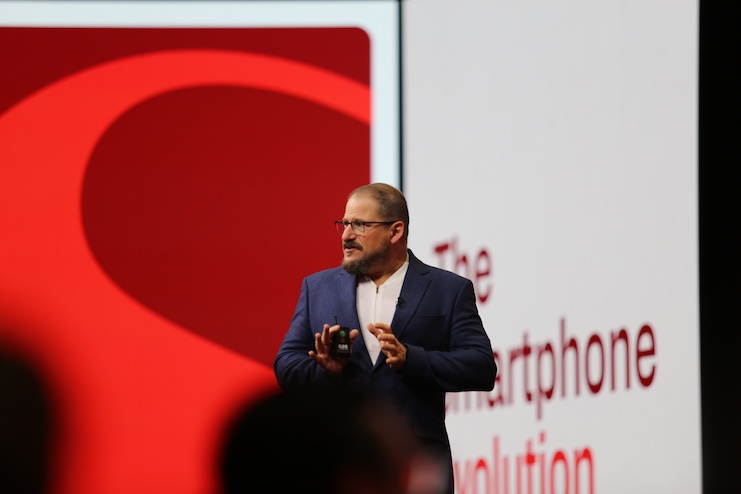
This was the throughline in Qualcomm CEO Cristiano Amon’s opening keynote today at the Snapdragon Summit. Consisting of several segments that stretched over 2 hours (more on those under separate cover), Amon set the tone by defining the macro environment.
That’s an environment increasingly characterized by agentic action. Covering everything from social interaction to productivity and shopping, it’s all about empowering agents to do life tasks – think: buying a concert ticket – with the right balance of human intervention and intent.
Though this vision isn’t fully materialized in today’s consumer usage, it’s where things are clearly moving. Gated by several factors – energy, compute, and privacy/trust – Qualcomm sees this as the puck it needs to skate to. And it’s basing its product road map on unlocking that future.
But it’s a future that’s already here to some degree, Amon says, pointing to the accelerated usage growth across AI engines from ChatGPT to Gemini (Google is a close Qualcomm partner). The point as it relates to Qualcomm? Processing will be the heartbeat that drives it all.

Sit at the Center
This means chipsets will be purpose-built for agentic AI’s computational needs. We’re talking everything from listening to reasoning to acting. Snapdragon’s SoC architectures will increasingly drive such sequences, including CPU, GPU, NPU, and other components.
This can be seen in the two chips announced today under the 8 Elite Gen 6 banner (more on those in a bit), as well as vertically-integrated systems Qualcomm achieves through partnerships. That vertical integration is critical for performance and efficiency in compute-intensive agentic AI.
And the device that remains at the center of the agentic movement will be the one that many have predicted is going away in favor of a constellation of wearables: the smartphone. Amon asserts that the smartphone isn’t going anywhere. It’s the right device to sit at the center.
That’s mostly because it’s so ubiquitous, giving it the installed base and scale required to reach across populations. But it’s also a device that’s so personal and trusted. It therefore knows us better than any other device, which is the context required for agentic AI to do its thing.
Of course, the mobile device will be joined by several others – vehicles, wearables, seeables, hearables, and touchables. That coverage will further enable an embedded position in our lives to gather the right context and execute tasks in and on our pockets, wrists, and faces.
Just Say Yes
That last part – faces – is of course where we focus, and it represents the best vantage point to gather a humanistic visual perspective. But XR is just one piece of the puzzle, and one of the places where Qualcomm has established Snapdragon as a go-to processing platform.
Beyond XR, Snapdragon’s positioning across device classes is something Qualcomm has been building for years. Branching out from mobile devices – partly driven by the need to diversify after Apple started building its own chips – it has blitzed all things non-smartphone.
That includes everything from watches to cars. And with that embedded positioning, Qualcomm now finds itself – through some noteworthy foresight – in a position to drive the multi-device agentic age. The more devices in which it’s embedded, the more systemically-agentic it can be.
That goes back to both inputs and outputs. All of these devices that orbit the smartphone will be key touchpoints for gathering personal (and permissioned) data and context. And they’ll be the same touchpoints – again, pockets, wrists, and faces – where agentic outputs occur.
To color all of that with an example, smartglasses can help shop for a new computer by identifying them in a retail setting, looking up specs, factoring in personalized needs, making a recommendation, finding the best deal online, then transacting on the spot. All you do is say ‘yes.’
Heterogeneous & Hybrid
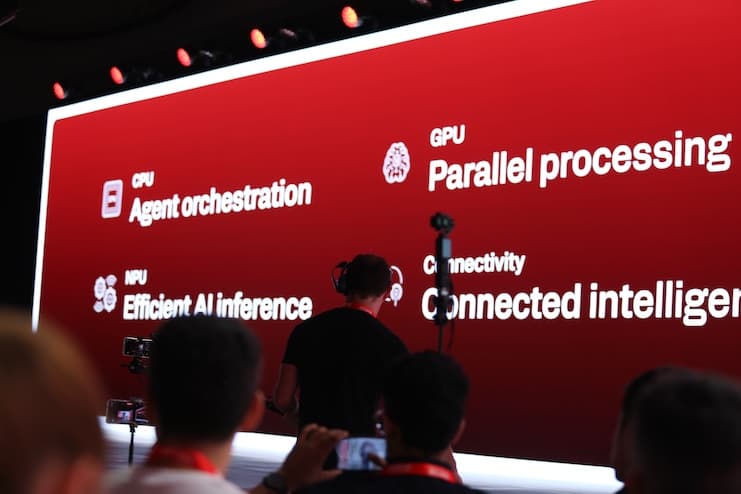
So how does all this happen at the chip level? Much of it is built around Qualcomm’s heterogeneous computing and hybrid AI. It’s all about load balancing and system optimization, including processing across device(s) and cloud, while reducing power and thermal output.
This approach positions the CPU to handle performance and orchestration. The NPU meanwhile handles efficient AI inferencing, while the GPU handles parallel processing. Finally, connectivity incorporates the cloud as well as inputs (voice, visuals, etc.) from other devices.
All those other devices are a key piece of the puzzle. As teased above, we’re talking about everything from cars to smart glasses. These are not only the endpoints for agents – with rich input and output potential – but they’re orchestrated for load-balanced hive-mind efficiency.
That all brings us to the latest culmination of these principles: 8 Elite, Gen 6. Consisting of two variants – one plain and one extreme – it’s the new high-water mark in agentic processing. It’s the most advanced 8-core CPU architecture and the first to break the 5 GHz barrier.
It boasts a flex cache architecture to constantly move resources across the CPU (agentic friendly) and its Hexagon NPU is the heart of the system to run AI models. Of course, that only scratches the surface, but you can see more in the supercut below and more from us throughout the week.