
 by
by 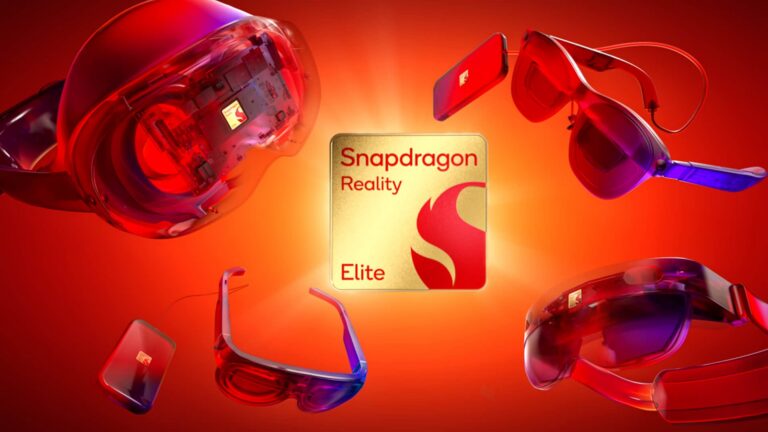
Qualcomm has launched the next phase of XR processing from the AWE stage. Known as Reality Elite, the new branding and capabilities were unveiled by VP and GM of XR, Ziad Asghar during his keynote address, and it will get its first chance to shine in Xreal’s Project Aura.
Reality Elite carries the evolutionary torch from the series of chips that previously sat under the “XR” designation. In that sense, it picks up where the XR series left off, making this the spiritual successor to XR2 Gen 2, which powers Samsung Galaxy XR and a few other headsets.
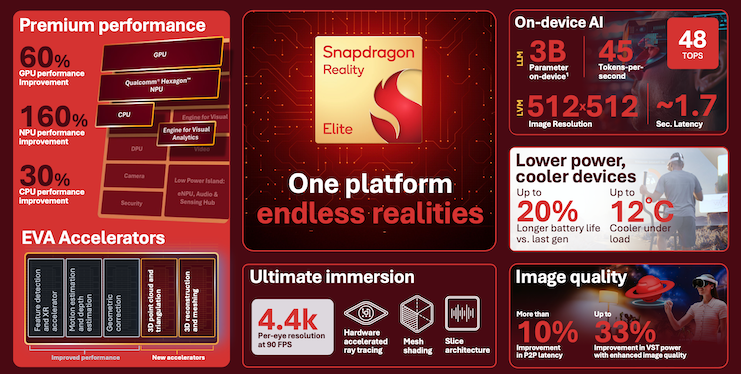
When comparing it to that previous XR flagship, what does Reality Elite offer? The highlight reel includes 60 percent higher GPU performance, up to 30 percent greater CPU performance, and up to 160 percent greater NPU performance. It also offers better hand and head tracking.
Altogether, this gives XR developers more horsepower to push experiential limits. Practically, that translates to sharper detail, smoother motion, and higher color fidelity. To quantify these optical capabilities further, Reality Elite supports visuals up to 4.4K per eye at 90 frames per second.
During a press and analyst briefing we were given last week, Qualcomm’s Matthew Dehamer explained how all the above functions, among other things, enable video-passthrough for mixed reality experiences that have greater resolution and lower motion-to-photon latency.
Various Permutations
While achieving those elevated levels, Reality Elite does so with greater power efficiency than its predecessor. It specifically offers 20 percent longer battery life at the same workloads, and up to 13 degrees Celsius cooler. This is an underrated but key factor for tech that goes on your face.
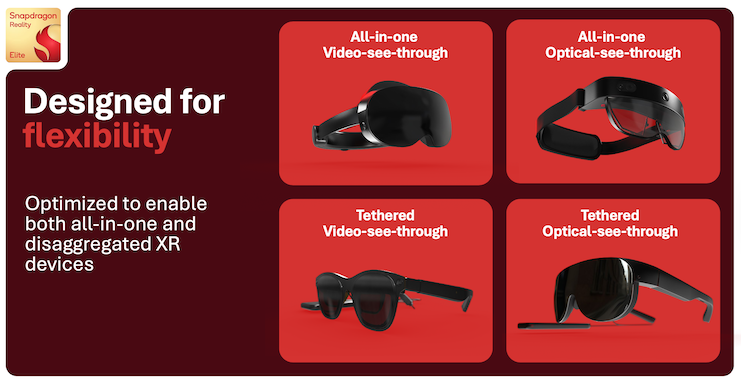
But Reality Elite’s hallmark could be its versatility. It can power a range of XR form factors, which is fitting given the ongoing divergence and diversification of XR hardware. This includes various permutations of optical see-through, video passthrough, standalone, and disaggregated.
It’s also built to power the increasing integration of AI into spatial experiences. This includes generative AI that’s deployed in 3D formats, as well as AI that powers situational intelligence in smart glasses, multimodal AI for object recognition, and scene understanding in mixed reality.
Specifications include 48 TOPS of AI processing, the ability to run large vision models (LVMs) and large language models (LLMs) directly on-device. Meanwhile, the NPU can run a 3 billion parameter LLM at 45 tokens per second, and an LVM can run with about 1.7 seconds of latency.
We’ll get to see how these specs play out in real-world conditions as XReal’s Project Aura is let out into the wild in the coming weeks. In fact, we hope to try the device today here at AWE, where both Xreal and Qualcomm are offering demos in their collaborative AWE mega-booth.
Lowering Barriers
Shifting gears, Qualcomm has separately announced its new START platform. Short for Scalable Turnkey AI Ready Toolkit, it’s an off-the-shelf resource to build smart glasses. This is meant to reduce friction and accelerate time to market for new smart glasses manufacturers.
START will specifically include design support as well as Qualcomm silicon (e.g., AR1+ chip) and other integrated middleware. The program will accommodate a range of AR glasses form factors (sensing a theme yet?), ranging from non-display AI glasses to devices with in-lens displays.
That last part is well-timed given the influx of non-XR eyewear companies that are entering the smart glasses space. Following the demand signals that have been validated by Meta and EssilorLuxottica, START will lower barriers to entry for fashion and eyewear brands.
And it’s already working. Qualcomm named U.K.-based Inspecs as the program’s launch partner. Inspecs runs several popular eyewear brands such as O’Neill and Barbour. Joining the eyewear brands in the Android XR ecosystem, the smart glasses market is about to see lots of action.