
 by
by 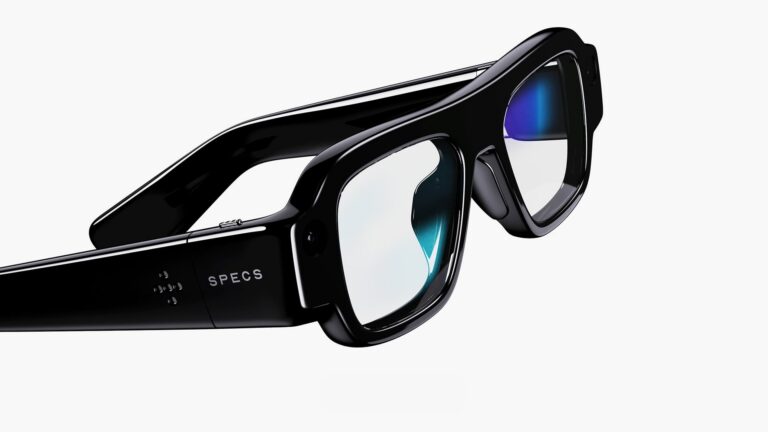
After much anticipation in the AR world, Snap CEO Evan Spiegel unveiled the company’s consumer-focused AR glasses moments ago from the AWE conference stage. With the streamlined “Specs” moniker, the device will be the center of Snap’s AR universe going forward.
More accurately, the device sits under Snap’s wholly-owned subsidiary, Specs Inc. There, it will exist as a rare ‘full-AR‘ product, including dimensional visuals that understand and interact with users’ surroundings. This deviates from a trend towards visually toned-down AI glasses.
So what are Specs, and what are their ‘specs’? The optical-seethrough format is built from high-performance Swiss TR90 polymer. The standalone device (no tether or compute puck) is available in two sizes to accommodate varied head sizes: 47mm (132 grams) and 52MM (136 grams).
The AR optical system is built using Snap’s proprietary LCOS display, which offers a 51-degree field of view – the perceptual equivalent of a 24-inch desktop display or a 115-inch virtual cinema screen. The display is capable of 16 million colors, but brightness (in nits) wasn’t specified.
Dimensional & Believable
Meanwhile, removable inserts accommodate a range of prescriptions, while electrochromatic lenses offer dynamic shading and opacity that can shift from clear to tinted in 10 seconds. This is meant to broaden the device’s usability, and thus appeal, in indoor and outdoor contexts.
As for battery life, Specs offer up to 4 hours of mixed-use on a single charge, including audio and video playback. An included charging case will carry four additional charges, offering a grand total of 20 hours of battery life. This is a big improvement from Spectacles’ previous generations.
Speaking of previous generations, Specs are likewise built around a dual Snapdragon SoC architecture. One processor handles computer vision, such as scene understanding and hand tracking, while the other powers AR content and lenses. This is done for optimal load balancing.
Specs will run these functions with 7-millisecond motion-to-photon latency, which brings us back to full-AR capabilities. Defined in our spatial spectrum as ‘dimensional AR,’ Specs processes scene geometry and context so that visuals can be integrated dimensionally and believably.
Head Start
This dimensional AR capability importantly expands the universe of potential use cases. Snap mentions a few, while others will develop, including navigation, spatial measurements, learning a new instrument, contextual AI assistance, entertainment, productivity, and screen-mirroring.
But when it comes to content, the headline for Specs is that the device has a several-year head start. Snap has cultivated a massive base of Lens Studio developers, and the platform’s capabilities have increasingly evolved from handheld to headworn experience creation.
This lets Specs hit the ground running with a base of experiences that happen on the device. Out of the gate, this includes hundreds of lenses already developed. Snap will further accelerate this sequence with new developer programs launched today, including some vibe coding tools.
For example, its Agentic Development function in Lens Studio helps creators streamline key processes like prototyping, testing, debugging, and publishing lenses. Snap is also launching Migration Agent to port existing projects to Specs. The theme in all cases is lowering friction.
Full-Fat AR
Beyond a developer network and toolset, another advantage that Specs holds is the device’s vertical integration. Snap has spent several years building a full AR stack. This includes hardware, optics, developer platform, proprietary operating system, and other IP covered by 7,000 patents.
This brings the textbook advantages of vertical integration, such as sensor fusion and a more elegant integration of hardware and software. This is always an advantage in consumer tech (see Apple), but goes into hyperdrive with AR glasses, given their advanced computational workings.
Lastly, coming full circle, Specs is taking the rare approach towards fully-dimensional AR. While the rest of the AR world zigs towards computationally-simpler ‘flat AR‘ (or no visuals at all), Specs zags towards full-fat AR. It’s a bold bet, and we’ll watch closely to see how the market speaks.
Meanwhile, Specs are available for pre-order today for $2,195 with a $200 refundable deposit, and should ship in the fall. Shipping initially will include the U.S., U.K, and France, with other regions likely to come. We’ll report back as we hear more, here at AWE and in the months ahead.
Update, 10:00am PST: to underscore Specs’ wearability and design, Snap has separately announced a campaign called Visionaries. Built around a photo series by acclaimed fashion photographer Steven Meisel, it will feature celebrities and public figures wearing Specs.