
 by
by 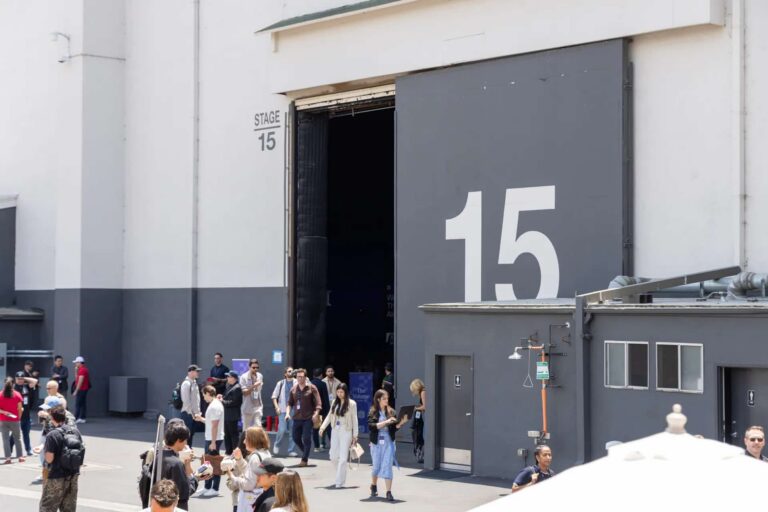

While recently attending the 4th annual AI on the Lot, the world’s largest conference for professionals working in the generative AI media space, I had moments of Déjà vu that brought me back to earlier times in the XR industry. This wasn’t an AI hallucination, but I found myself walking along the Culver Studios backlots to Amazon MGM’s Studio 15, where its massive 80ft LED virtual production space resides, and running into people that I know from the XR space along the way, as if it happens every day.
The crossover between the burgeoning AI industry and XR has its overlaps not just at Augmented World Expo, our largest industry gathering, but now also at places like AI on the Lot, where Hollywood executives rub elbows with technology professionals and those genuinely trying to figure out where it’s all heading. As both of these industries converge in exciting ways, what initially feels like serendipity will increasingly become more common, especially on the eve of this year’s AWE USA, kicking off its third event in Long Beach, after making the move to SoCal in 2024. My hunch is that it will flow in both directions.
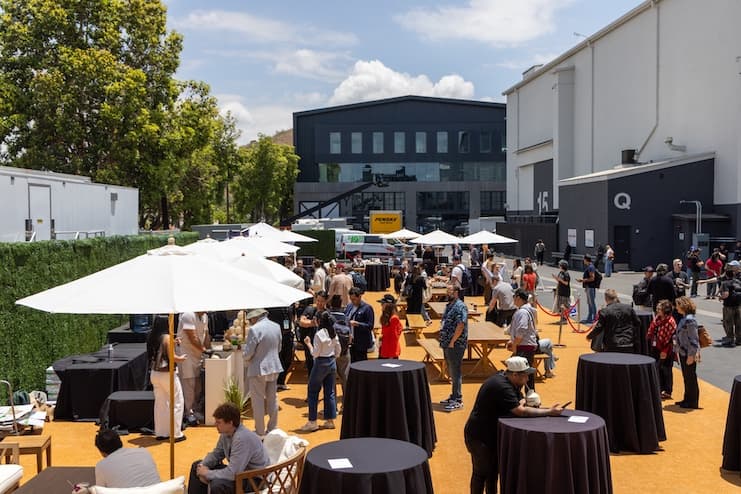
AI on the Lot was started in 2023 by Todd Terrazas, Ian Eck, and Mike Gioia as an excuse to bring together disparate parts of the AI community. That timing has boded well, and they launched that year with 1/2 day conference and 600 attendees, with the conference growing to 850 and a full day in 2024, to now 2.4K attendees and two full days in 2026. From an XR perspective, this conference has a tremendous amount of crossover to the conversations we currently find ourselves having in the XR space. Couple that with the creative horsepower of Los Angeles and its massive talent pool, and you have a tremendous mix of thought-leadership, technical aptitude, and professional problem-solvers working on the bleeding edge of entertainment and media.
Glimpsing into each passing studio, the content like Dreamina AI: Storytelling and Worldbuilding in the AI Era genuinely intrigued me, and I was curious to know just how is AI impacting the film industry from people who are facing this reality every day and from many perspectives in the creative industries. The audiences packed the halls to hear from traditional filmmakers making the switch to including AI workflows into their creative processes, as well as the technical wizards who make it all possible.
Standout sessions for me touched on topics I hold dear: legal frameworks and better-together stories of people joining forces across industry to keep humans in the loop and at the negotiating table. It was no surprise seeing XR Hall of Famer Joanna Popper on stage and moderating an important conversation on Section 230 and Generative AI on the Internet.
Creator rights and AI will continue to be the battlefield of AI, and the discussions worth having. Case in point, Cinematic Movie Scenes with Kevin Cardoza and Adam McFarland hosted a live demonstration of generative AI music platform Suno. They demonstrated how well a text-based prompt for “Dark Choral Gregorian Chant” could create the vocal and instrumental soundscape for your next timeless fantasy film in real-time using generative AI. The Suno platform itself has been the subject of several lawsuits, but in November 2025 agreed to a $500 million dollar settlement with Warner Music Group, allowing them to train on its music catalog. I appreciated that the organizers sought to present all sides of the industry, even showcasing the more litigious corners of the space. It’s hard to deny how astounding the outputs are, but the ethical debate remains. In effect, all aspects of the daily conversations we have in tech circles and creative industries were bouncing around the conference.
And that bouncing happened both in person as well as in a simulation, seeing as the conference’s organizers had created a digital twin of our attendee profiles so that our digital twins could meet other attendees and interact and network with them while we were at the conference. My digital twin met an order of magnitude more people than I did, and asked some brilliant questions, but I didn’t really get to observe it in real-time. I got to take a look at that output at the end of the show, but how to really engage with the information beyond the demo, that was less clear. Still, they pulled it off, and it was a fascinating real-world application of AI to theoretically maximize your time both in the real and virtual worlds.
Running into friends and colleagues from our industry highlighted to me a paradigm shift in the creative industries, or what the opening remarks of the conference referred to as “gravity”. Many people are meeting the moment not with skepticism, but with adaptation and curiosity. For example, Kathleen Cohen, XR strategist, tech humanist, and owner of Los Angeles-based consultancy, The Collaboratorium, is welcoming the new offerings to encompass XR + Geospatial Computing & AI Entertainment, embracing the change, more of which she says will be shared in the coming weeks. This approach bodes well as dealmaking, investment, and production are at the heart of the AI + XR intersection, especially in Hollywood.
We heard from Ted Tremper, Executive Director of AI Doc: Or How I Became an Apocaloptimist and Executive Director of the Creator’s Coalition on AI during his session The ‘AI Doc’: Inside the Creative Community’s Fight for AI Standards. Tremper is a masterful orator, so it was no small wonder that he is running an industry coalition that has already brought together thousands of film industry champions for responsible AI regulations among its other tenets. The Creator’s Coalition on AI was started a few years ago by Daniel Kwan, Director of Everything, Everywhere, All at Once, and other influential Hollywood heavyweights as a response to AI’s coming impact on the film industry. Since launching, global stars like Margot Robbie and Natalie Portman have added their names to support the creation of shared standards, definitions, and best practices as well as ethical and artistic protections for if and when AI is used.
The big takeaway for me was yes, things can still go very wrong, but together the industry has a responsibility to work together – and that standards and regulations are the key driver for making sure that they do everything they can so that it can go right. Chris Gardner of the Hollywood Reporter was the perfect inquirer, leading us down into very thoughtful, if not also worrisome territory.
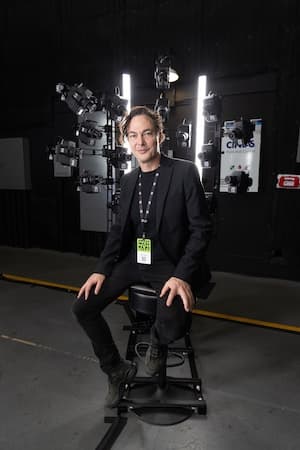
That XR crossover carried over to the show floor with longtime Augmented World Expo colleague Alexx Henry, CEO of BlueVishnu, who built his first scanner in 2013. Alexx was there showcasing OriginSpin, their “3D Portrait Calling Card” and while OriginSpin is powered by an Array of Canon R100’s, creating Gaussian Splats that allow you to reposition the portrait however you think it flatters you best, their 3D portrait was a perfect example of how to connect someone with the power of today’s tech.
There is no need to wish that you got your best angle, because the splat allows you to choose that yourself. Having recently done a portrait session, I was eager to see how this 3D portrait compared. I sat down for the shot, aided by expert lighting, and was truly impressed by how well the photo came out. I also learned that not only was Alexx exhibiting at AI on the Lot, but that he and the AWE community go way back, and he will be attending and bringing the OriginSpin set-up to AWE USA in Long Beach this week.
Henry shares, “In this particular scanner there are relighting techniques that are up and coming…actually it’s a huge throwback for me personally as a photographer. I’ve loved lighting. That’s always been something that I was passionate about as a photographer. People and lighting, and just people with good lighting. When you’re a photographer, you make choices, so we’re kind of taking one of those choices — of where that frame is — and just giving it to the subject. You can actually make that choice.”
Watching Alexx reframe photography as a 3D experience using Gaussian splatting is exactly the way that past domain expertise coupled with new technology connects with this moment. For the creators that keep pushing the boundaries of what’s possible using AI or reimagining their work thus far through a new lens, the fact remains: nothing is static.
Between the sessions and conversations, the thought I kept coming back to was this – the “gravity” of the show is a signal that people and industries are adapting. AI on the Lot, reminds us that everything you build, becomes a building block for the next thing, and that gravity with its double meaning meets the moment best – pulling us in, but also with the weight of its importance to everything that comes next. With AWE USA kicking off today, I’ll be keeping an eye out for those sessions and speakers who translate and transcend, and new imprints start taking shape in the wild. Serendipity or not, I’ll be glad to be there.
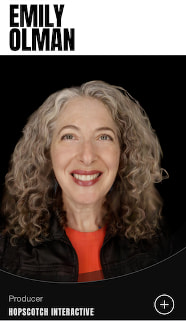
Emily Olman will be speaking at AWE USA 2026, taking place June 15–18 at the Long Beach Convention Center. Catch her session, The Known Unknowns: Storytelling at the Frontier of Immersive Film, on June 18th from 2:30–3:30.