
 by
by 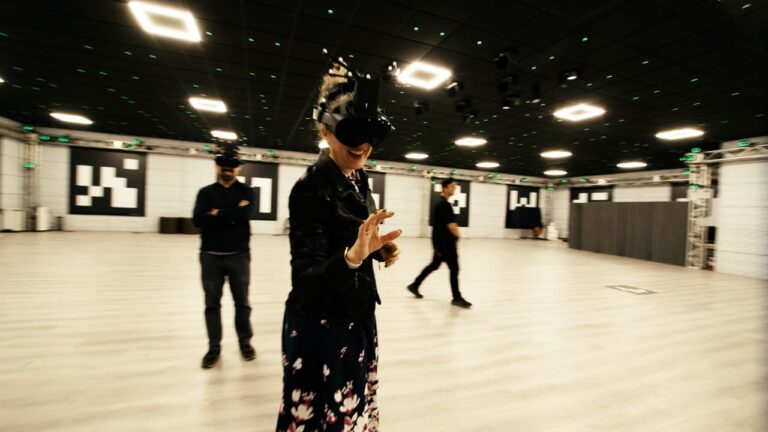

While visiting Austin during SXSW, I planned the ultimate side quest before my flight home to visit the site of the Four Seasons Private Residences Lake Austin. The development site, 210 acres of green hilly land with panoramic views above Lake Austin, and a mile of shoreline, is the most ambitious luxury development in the United States. Here, the residences start at $4 million dollars, private villas at $15 million, and penthouses at $30 million – a tiered menu of ultra luxury living where “once you’re in, you’re in”, per their sales team. All amenities are there for you and your guests to enjoy, from the Lake Clubhouse to the Wellness Center to the 42 boat slips. Unlike other resorts that carry the Four Seasons name, the Lake Austin development is the first purely residential private resort to do so.
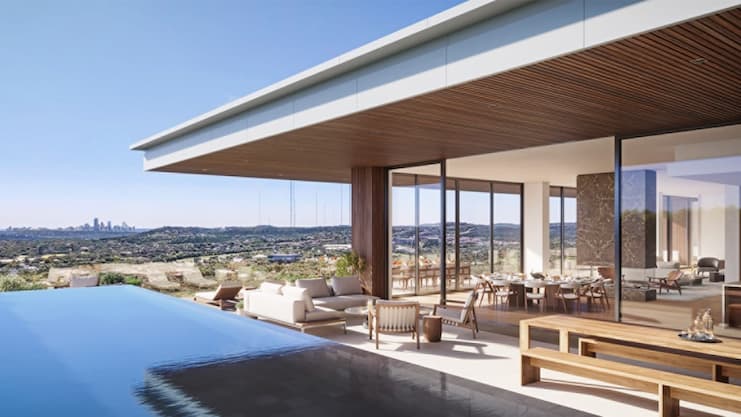
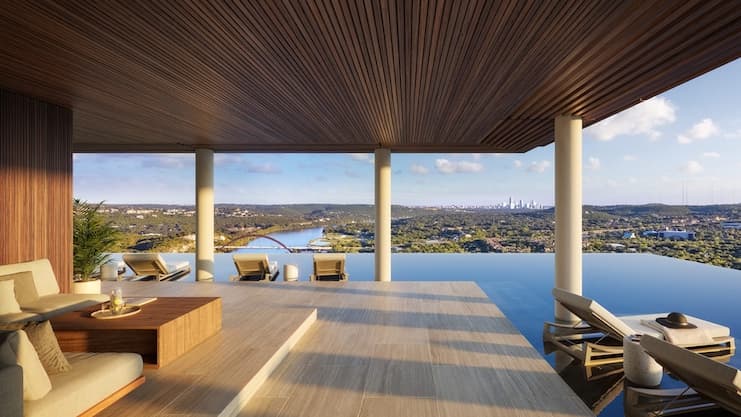
We met at the sales office just on the other side of the gate and jumped into a Cadillac Escalade with Ezra Cruz from the sales team. When we arrived, we were greeted by a few of the security officers who guard the land. They were working on clearing some of the acreage because, while in the future there will be a restaurant where I was standing, it was then just an observation deck with views of the sparkling lake about 380 feet below us, downtown Austin in the distance, and the aptly named 360 Bridge across the glassy lake.
As we enjoyed the view, we could see the wake of an early-morning water skier rippling out across the dark blue water. The security detail who were there to chaperone us were clearly experienced at working for high-profile clients, and while the ride up the bumpy road reminded me more of being on BLM land in Central Oregon near where I grew up, I understood that in three years it would be completely transformed into one of the most modern and luxurious private developments in the world. But right in that moment, I was looking at a metal observation tower on a clearing, a dirt road that eventually will lead down to the docks. And to my left was a 5,000 square foot free-roam VR rectangular Holodeck, created by Agile Lens, DBOX, and Pureblink for the site’s developer, Jonathan Coon.
I was intrigued by what I had heard about Agile Lens’ cutting-edge use of LBVR in the fall of 2024 when I heard CEO Alex Coulombe present details of the project while at an SVVR meet-up. Jonathan Coon, I learned, is someone just as ambitious and creative as our friends in the XR space, but with a lot more money. Coon is also a unicorn breeder. In the 1990’s Coon founded 1-800-Contacts in his dorm room at BYU, and later sold it for $900 million, but not before spending years in D.C. lobbying to change the law so that contacts could be sold directly to consumers. Later, he financed the indie film Napoleon Dynamite, which was produced and edited by his brother Jeremy Coon. He gives all credit for the film’s success to his brother, but “Vote For Pedro” became a meme, before memes were a thing, and Napoleon Dynamite, although produced on a mere $400,000, went on to gross $46 million worldwide.
To say Coon is driven would be an understatement; his obsession with doing hard things was surely at play when he hatched the plan to build the world’s most state-of-the-art residences. And, this is presumably what led to him hiring Agile Lens and DBOX to create a corresponding state-of-the-art sales experience for the Lake Austin development, enabled by a location-based, fully immersive Holodeck.
Having known Coulombe since 2018, I knew that as an architect and talented XR developer, the chances were high that this might be the holy grail of Real Estate XR that I had been looking for. And I knew that the hush-hush nature of the project meant that there was most certainly some secret sauce.
Unlike standard 360-degree tours often used in real estate, this project uses an actual Holodeck – a 5,000-square-foot physical stage where buyers can physically walk through unbuilt residences together in virtual reality. This brings us to the edge of the possible in today’s real estate previsualization techniques. Many companies have built demo rooms, relying on game engines or 360° virtual tours using reality capture. But to combine the physical space and the virtual environment 1:1 is a leap further, and requires much, much more technical expertise and know-how, not to mention creative problem-solving.
Ezra explained that when the observation tower was built, there were still trees blocking the view. But by the time I visited, the trees had been felled, opening up the view to Lake Austin below. This is one of many ways in which the VR experience not only enabled selling the unbuilt, but also overcame pre-visualization challenges. In VR, the view is a digital “as-built” enabling us to feel 100 feet closer to the edge, and more like what the experience would be like in the finished restaurant and on the terrace hovering over that jaw-dropping view with deep blue Lake Austin glistening below.
I started creating virtual tours for real estate in 2015 using the Matterport Pro1 Camera (MC200), and have been hands-on in the 10+ years since, as the evolution of real estate pre-visualization has turned more into a game developer workflow than one of actual drafting in computer-aided design, aka CAD. Renders used to take a long time to create. But now with AI, a simple sketch can be transformed into a compelling video with animations and virtual day-to-dusk transitions – the sexy sales materials that realtors are always clamoring for. Still, when you’re hoping to make a sale with seven figures, you can’t leave your best sales tools to chance.
If you had the time and resources, the vision behind the sales funnel at the Four Seasons Private Residences is what you would get. There is no reality capture happening because the villas themselves won’t be built for a couple more years. What they are selling is the dream of the ultimate reward – Valhalla for the ultra-wealthy, and the allure of a highly coveted location and community. This is where the VR experience with 1:1 room-scale that showcases the unbuilt amenities and the multi-user format would be essential.
It was very important that, whether it was a couple or a family, the shared experience in VR would be a central feature of the sales walkthrough. When I visited, 40 percent of the residences had already been sold, generating half a billion in revenue, driven by an XR experience that let them immerse themselves in this private resort before it’s built. And every single buyer had gone through the XR experience. The obsessive attention to detail was paying off.
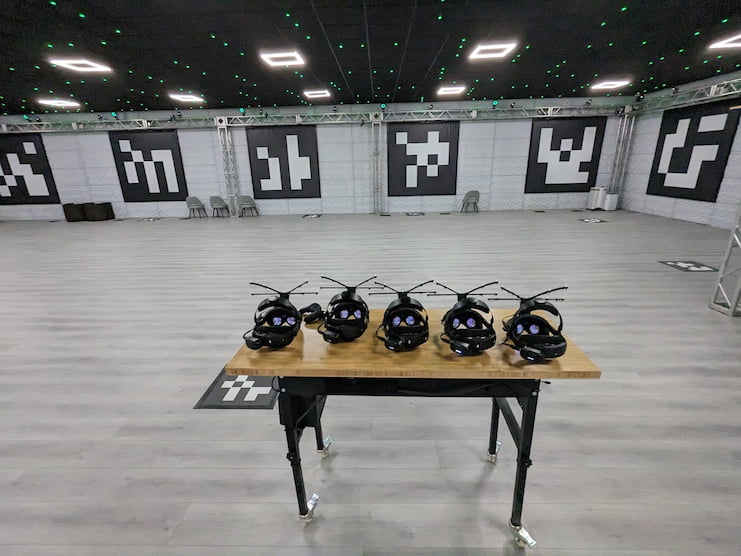
Alex and the team at Agile Lens have been creating XR experiences for more than 13 years. But prior to this project, they had always had clients for whom the outcome was “good enough”.
That all changed when they started working for Coon and building this experience.
The Holodeck manager shared with me that the primary goal of the VR experience is not just visualization, but memory creation. I know from my years in real estate marketing that the emotional connection and those visceral cues are so important. The fidelity of this experience is so high that it is designed to entirely hijack the senses, a worthy use of full-occlusion and HMDs to keep you immersed in the experience. However, since so many people are coming into VR for the first time, they leave the lower 1/3 of the headset open, to keep the real world in view. By allowing clients to physically walk through the space, look over railings, and sit on furniture, the brain encodes the experience as a physical memory rather than just a picture they looked at. This creates an emotional attachment to the property that brochures cannot achieve.
“Emily, okay, if you would like, if you’re feeling ambitious, you can actually sit on this couch.”
– Cole McArthur, Holodeck Manager and my guide
We enter the Holodeck, and I’m reminded of the familiar XR free-roam halls that I’ve seen at AWE USA, EuropaPark’s Yullbe, and the ISS Space VR Experience. It most resembles the latter, walking through the International Space Station at Richmond’s Craneway Pavilion – an empty room with a few physical props that enable the users to act naturally in the space. This room, I can see, has been fully rigged to know exactly where we are at any time, tracked and guided to execute a flawless experience every time.
The tour is a scripted 30-minute experience managed by a Holodeck Manager who ensures the sales narrative is controlled and perfectly timed, leading clients from the penthouse to the restaurant, and finally to the theater.
The system is built for “local multiplayer,” meaning the prospective buyer does not experience the home alone. And in this shared experience, the prospects all wear headsets and occupy the same virtual space simultaneously. They can see each other, talk naturally, and point out features. The 1:1 movement and room scale functionality, plus Meta’s Airlink system, keep people flowing through the experience. Physical props like real chairs augment the experience to bring you fully into the illusion. This is a wide departure from a virtual tour, because it blends the physical and the digital, mapping the experience to the visuals in headset. And it considers many, many more details than I have ever seen in an XR experience for real estate.
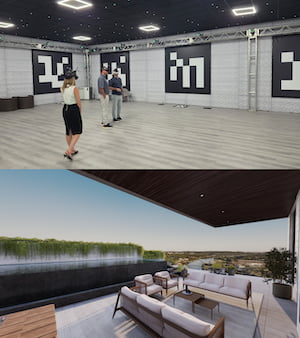
The walls are adorned with luxury modern art, and professional golf is on TV. The view from the terrace and the seats at the restaurant and Lake Clubhouse are 1:1 with the line of sight of the actual space. This is not easy to achieve in 360° photography, yet because of the use of Unreal Engine, it all feels elegantly done. In fact, future updates that may already be rolled-out include material swapping and time-of-day simulation with substrate and lumen enhancements.
But importantly, all this detail has not only resulted in phenomenal presales numbers, but it translates to real clash detection prior to building. For example, appliances are all 3D modeled off of the real brands like Gaggenau ovens. So when they build in the VR model, architects can notice that the placement of two appliances would not fit the space as intended. So the notion of “pixels are cheaper than atoms” is also useful as a way to avoid costly construction revisions.
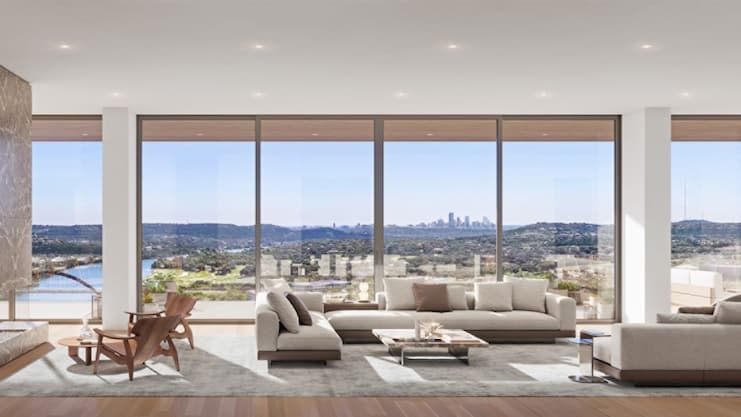
I was able to tour around much of the property and its amenities, but of all of those, I felt the residence captured the power of the XR experience the best, overcoming a common objection that people have when looking at floor plans, that they cannot imagine how big it feels. In this case, the 7,000 square foot five-bedroom penthouse felt regally large. And walking around the kitchen with two dishwashers, looking at the floor-to-ceiling windows with the views of downtown Austin and the lake, and the scale just made me understand exactly how big and grand it would be.
“And I, I want to just emphasize that because in real estate, people have the hardest time visualizing something that’s not there. But in this case, you know, we’re transporting somebody into a property that hasn’t been built yet. And I can actually have a really good sense of how many square feet this is.”
– Emily Olman, in experience
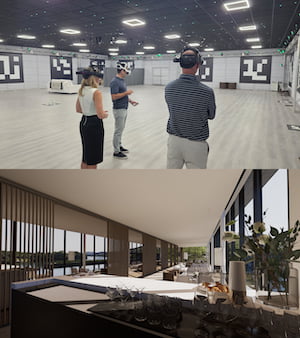
For me, the XR technology faded quickly into the background as I felt entirely immersed, which makes me pretty certain that it’s only a matter of time before this level of VR previz will be expected for ultra-luxury properties. It will also trickle down to other projects, perhaps as AI will unlock various flavors of a poor-man’s previz. For developers and realtors who are trying to sell that which does not yet exist, this is the way to overcome so many of the challenges that are inherent when people can’t visualize their future property.
Cole: I’d love to have you weigh in on what is called a healthy and spirited debate about which is the best seat in the restaurant. Is it this corner table or this corner booth? What do you think?
Emily: Let me see. Yes, please. Moment. Okay. (As I walk up confidently to the wall) The best seat in the house. You know, I actually think it’s this one.
Cole: I’m with you.
Emily: And I say that because it’s typical also in 360, when we are trying to show the grandeur of a space, we don’t put the camera in the center of the room.
I left wondering what other XR amenities and yet-to-be dreamt-of smart home features will bring. In another milestone for the project, a construction loan to the tune of $870 Million by TYKO Capital was secured earlier this month – one of the largest ever made for a luxury residential project in Texas.
In the meantime, selling half-a-billion in presales, and counting, with VR is an industry accolade worth sharing. I hope that developers and brokerages take notice of the value they could be creating with XR from its best and most functional example. And even more exciting, as phases of the project are completed, devices such as Apple Vision Pro and Snap Spectacles could open up new in situ experiences that push the limits further.
That is to say, there will be a time in the not-so-distant future, when today’s bleeding edge isn’t an edge anymore. A real restaurant soaring over a lake, and the unbuilt magic of tomorrow becomes a new tabula rasa for immersive experiences. And that is the best table of all.

AR Insider’s Editor-at-Large Emily Olman is an XR community builder, roving journalist, and CEO & Chief Media Officer of Hopscotch Interactive.