
 by
by 

Apple has WWDC, Google has Google I/O, Microsoft has Microsoft Build. These are all big conferences, but not specifically dedicated to XR. When it comes to events that focus squarely on extended reality, there is no doubt that Augmented World Expo is the one to watch, and this year has been no exception.
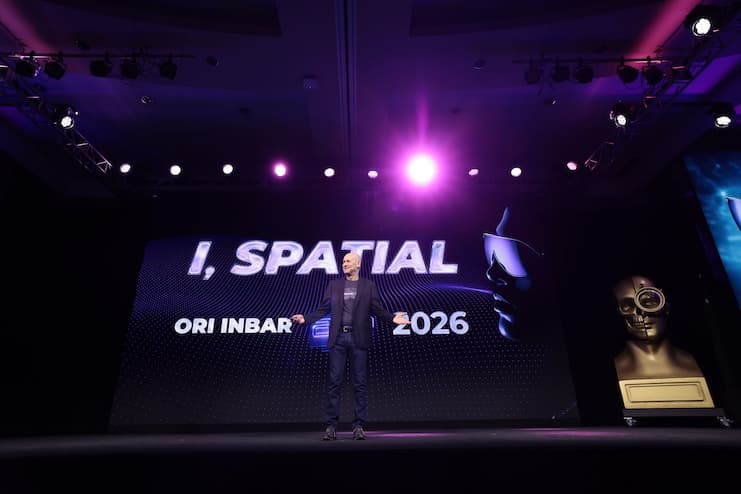
This year’s AWE had two themes. The first was “serendipity.” The show’s co-founder and CEO Ori Inbar encouraged everyone to embrace the chaotic nature of in-person events. To network, attend panels, ask questions, socialize at numerous after-parties, and to go with the flow. In my case, this worked. I did make noticeably more connections at this year’s AWE than at any of the previous editions.
The second, more playful theme introduced this year was “I, Spatial.” Evoking Asimov’s “I, Robot,” it symbolized a thoughtful embrace of artificial intelligence by the XR community. Thoughtful because “I, Spatial” is supposed to represent an alternative, rebel track in AI development, making it more spatial and empowering humans rather than replacing them. Within this framework, Ori welcomed contributions not just from AI enthusiasts but from everyone, arguing it is up to the XR community to help steer AI toward a more human-centric approach.
Specs Reveal
One of the major anchor events for this year’s AWE was the reveal of Specs, an augmented reality device by Snap Inc. The device comes in the form of all-in-one glasses, with compute and battery embedded inside.
Unfortunately, despite the reveal, the in-person demonstrations were done using a previous-generation developer kit. This was not communicated very clearly, which meant some attendees had an underwhelming experience of what they thought was Snap’s latest product but was, in fact, a legacy dev kit. The company was also refusing to do demos in private, which led to a lot of speculation. Some said the glasses contained a flaw that could not be fixed in time, while another rumor suggested a legal issue prevented Snap Inc. from doing open demonstrations. Either way, the Specs announcement was a kind of soft reveal, with preorders available at $2195.
Despite the lack of hands-on impressions, industry pundits reacted largely positively. Snap is seen as deepening its commitment to the XR space and establishing a new line of products. On paper, the glasses promise fully spatialized computing in a 170g form factor. This puts Specs at the frontier, with no direct market competitor and with Meta’s Orion prototype being the closest in nature.
Outside of the industry, however, the reception to Specs has been mostly negative, with the average consumer seeing the glasses as bulky, expensive, and aesthetically unpleasant. The Snap stock price dropped more than 20%, and so far has not rebounded in later sessions.
Personally, I am happy to see a new AR device and to see yet another large player enter the space, but at the same time it is important to understand that Specs will be a tough proposition. The developer kit relied on a lease format, where developers could essentially borrow the device for a fixed monthly price, which is why there already exists a fair number of apps (called lenses) in the ecosystem. This lease system is now being replaced with an upfront $2,195 price tag, and that will no doubt make any developer think twice before committing.
XREAL AURA
XREAL’s upcoming high-end AR glasses have already been demoed at other events, most notably at CES, but they are finally available for preorder. The preorder system is a bit unusual. To reserve a spot, consumers have to buy a $99 pass, or $299 for the priority version. This amount will then be returned as credits upon purchase. So far so good. The problem, however, is that the price has not been finalized yet. XREAL is asking buyers to commit their funds without disclosing what the price will be.
While this method might seem strange, it has found success in China. XREAL expects demand to exceed supply, or at least wants to create the appearance of scarcity. This pre-sale method also helps to build anticipation and hype. I would not be surprised to see other companies adopt this strategy. In the small print, XREAL promises the total price will not exceed $1,500 (excluding taxes).
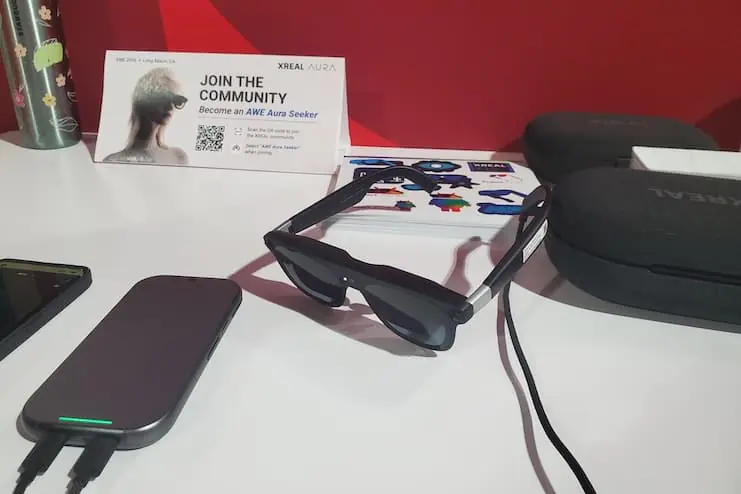
I had a chance to go hands-on with XREAL AURA and came away very impressed. Of course, it is not something that would pass a coffee shop test. AURA has a dedicated compute puck, and the display stack inside is clearly visible. Moreover, it does not use waveguide technology but the more obtrusive prisms, and as such, you cannot really see the wearer’s eyes. What it lacks in appearance, however, it more than makes up for in resolution, field of view, and processing power.
When using an application like Google Maps that takes up the entire 70-degree field of view, it becomes almost as immersive as a VR headset. I also tried browsing and playing mixed reality games. Everything from hand tracking to anchoring to performance worked flawlessly.
Smart Glasses Everywhere
It was not just Specs or XREAL AURA that attracted attention. Smart glasses were pretty much omnipresent at this year’s show. VITURE unveiled Helix, an industrial-grade device designed for enterprise. Emdoor, known mostly for affordable headset alternatives, demonstrated a whole suite of AI glasses, and Raven Resonance debuted Raven Prism.
I found Raven Prism particularly interesting. It is a privacy-focused device that works with ARM64 Linux, supports SSH, and keeps all eye-tracking and camera data on-device. It also aims to do AI inference locally, but ultimately this decision is up to the user. When released, Raven Prism will probably be the most privacy-focused AR device on the market. The downsides? A monocular display (right eye only) and 30° field of view. The expected price for Raven Prism is $1,499.
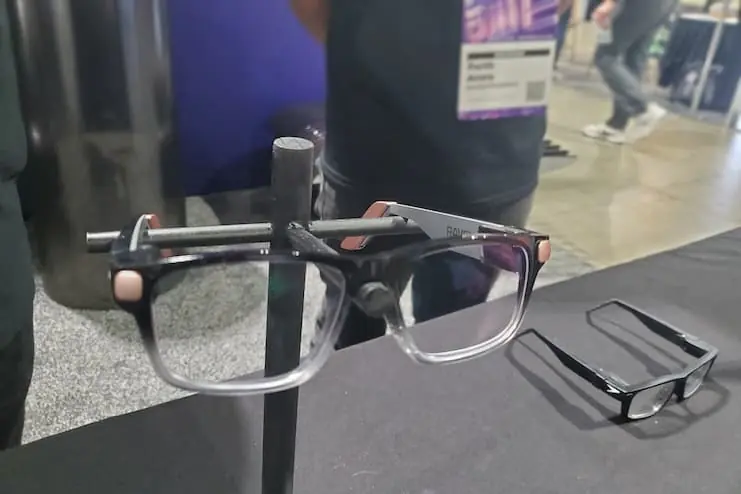
Unseen Reality was showing off URXR, its 5K (2448 × 2064 per eye) device with a large 90° field of view. The glasses admittedly have a pleasant futuristic design, but they do not come with their own operating system. For now, it is essentially a mirroring device, albeit with six degrees of freedom that anchor panels in space. Now here is the kicker: URXR actually uses passthrough for AR, but I only learned that later. The passthrough is done so well that I was under the impression I was wearing a transparent display. At the same time, I kept wondering how the 90° field of view is even possible. The mystery is now solved. URXR is therefore part glasses, part XR headset. The expected price for URXR is $899.
A rising tide lifts all boats, and this is also true for smart glasses. TDK was demonstrating its miniature low-power head-tracking chip, which can give any glasses a 3-DoF capability. Applied Materials and Lumus were busy showcasing their latest optical solutions. Peripherals, custom batteries, not to mention all the augmented reality studios, all benefit from the growth of the AR ecosystem.
Neural Inputs and Smart Rings
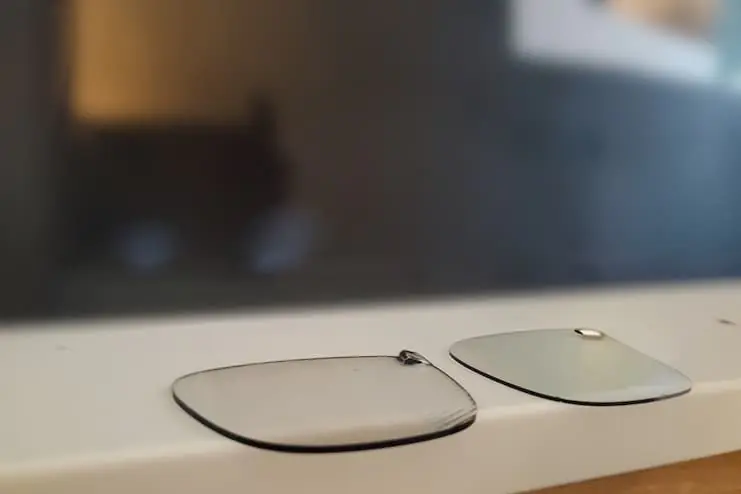
This year brought a visible increase in neural inputs. This category arguably came into prominence thanks to Meta’s EMG wristband. At the show, I had a chance to see a couple of alternatives. Their appeal is that they are hardware-agnostic, sold separately from glasses and at a competitive price. FetherLabs and Mudra are two examples of polished products that are already on the market.
Another rising category of wearables was smart rings. In fact, this year’s winner of the Startup to Watch Auggie Award was PROLO by CG Technologies. The ring offers swipes and taps, but also a mini touchpad that can be used as a cursor. The team was using PROLO to navigate smart glasses menus, but it can work with any other device of choice.
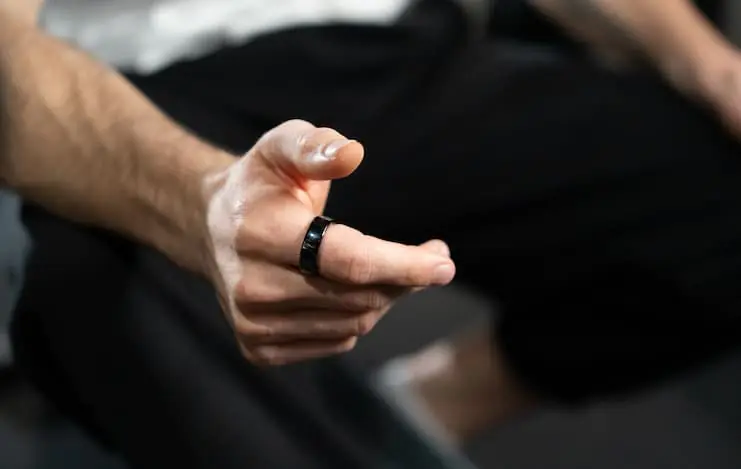
PROLO made a good first impression, but personally I was mostly wowed by KiWear. First of all, with its glossy black finish and green accents, the ring looks quite slick. We are talking about all-day wearables after all, so the importance of aesthetics cannot be overstated. But what impressed me just as much is its finger-tracking ability. The ring does not just support swiping and tapping but can also be used as a pointer. This opens new possibilities, where a finger could act as a remote, laser pointer, and be more broadly used in XR as an alternative input method. For now, I am not sure finger tracking is reliable enough for finer control, plus the ring is expected to cost $299, but it is exciting to see the innovation.
Unconventional Ideas and Solutions
This year’s AWE featured some interesting, unconventional projects. One is Jadu.AR, a collaborative platform that aims to upend existing social networks, or at least provide a spatial alternative. “Photos and videos have been optimized to death,” argues Asad Malik, the founder of Jadu.AR — “and it’s time for something new.” Jadu utilizes Gaussian splatting as its content form, and the purpose is to emphasize here-and-now experiences and real-world memories over the heavily engineered world of internet media. It is no doubt a very creative use case for Gaussian splats and spatial technology.
The grandfather of VR, Tom Furness, announced Luminara, the Institute of Light. A spin-off of the Virtual World Society, the Luminara Institute is a nonprofit that focuses on the use of emerging technologies for research, education, and human improvement. What was shown during the talk looked like guided meditation, with XR components such as drawing connection lines between participants. That is one example, but Luminara’s charter is quite broad, listing creativity, compassion, personal growth, contemplative art, among other areas. Both Luminara and Jadu.AR explore use cases for XR that are outside the box.

Art Pavilion and Gaming Pavilion
The expo floor featured two distinct pavilions dedicated to art and gaming. This increased the aforementioned serendipity. A more diverse representation of the XR community is always a good thing, and it made the networking and mingling more unpredictable. Fingers crossed for some unusual collaborations and projects coming from that intersection.
It also made the show floor more lively. Game developers and artists continue to actively leverage VR and AR, either as a tool or a medium. Visiting those pavilions, one could see a thriving ecosystem, perhaps bruised by uncertainty, but progressing nonetheless. This might not come as a surprise to those following the space, but for visitors who are familiar only with general narratives, the gaming and art pavilions presented a refreshing contrast.
What Next for XR
As always, training and education studios had a strong presence. There were locomotion solutions like the Freeaim shoes or Glydr foot controller. Abbott was on the floor asking for blood donations and coupling it with Apple Vision Pro as part of distraction therapy (definitely praiseworthy). Some sectors, such as virtual avatars and holograms, had a muted presence, at least compared to previous years. Haptics also did not have a strong showing, although bHaptics demonstrated their improved haptic gloves that rely on hand tracking.
Meanwhile, the space is abuzz with anticipation for the upcoming release of Steam Machine and Steam Frame. There is also excitement regarding the upcoming Meta Connect conference, scheduled for September 23rd. What exactly Meta is planning for Connect is not clear. But Evan Spiegel, when announcing Specs, made a small jab at Meta, calling them “copycats,” so perhaps he knows something we do not. We will watch this space closely.
Mat Pawluczuk
AR Insider Guest Author