
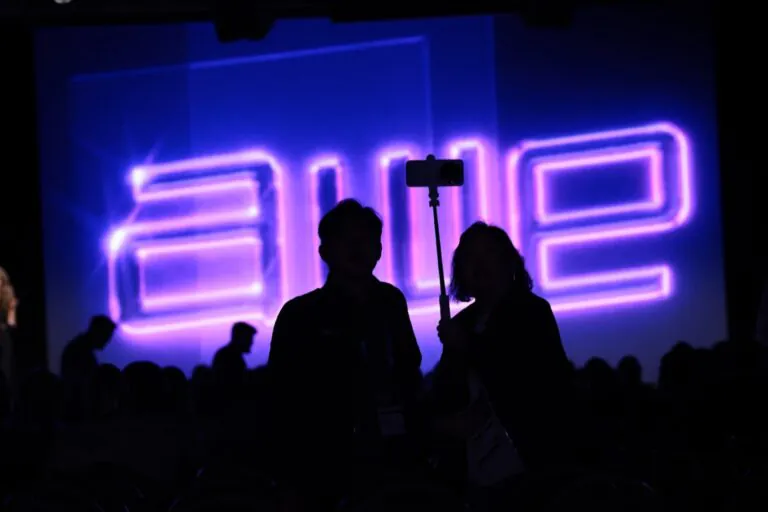

I had hoped this would be a great year for AWE. Six months earlier, CES was awash with AI smart glasses, most without a display, chasing the success of Meta’s Ray-Bans. I expected the release of Android XR would spawn a bigger ecosystem of both hardware and software, but it’s going to take a long time, which is going to give Xreal an extended first-mover advantage for what seems to be the right product at the right price.
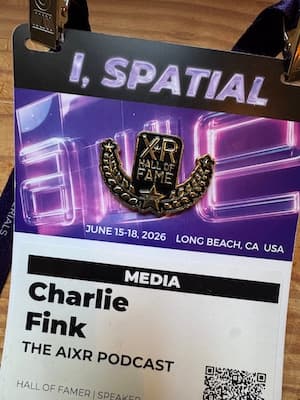 For me personally, it was an incredible milestone year. I have a special bond with this show and its community of creative developers and entrepreneurs. I worked on adapting flight simulators for entertainment in the 90s, and came back to cover XR for Forbes twenty-five years later. I was here at the beginning, and it is still the beginning, so for 1000 stories about XR in Forbes, two AR-enabled books, six years, and 295 episodes of the AI/XR Podcast, they inducted me in the AWE Hall of Fame, an unexpected honor I will always regard with great humility, because I know so many people who are more worthy.
Congratulations to the Auggie Award winners. Here’s the list of winners, and congrats to my fellow inductees. The 2026 AWE XR Hall of Fame inducted eight pioneers recognized for their significant contributions to the extended reality industry: Al Rodgers (Motion Tracking), Rebecca Allen (3D CG/VR Art), Karl Guttag (AR Display Analyst), Brett Leonard (Filmmaker), Lance Loesberg (360° Video), Charlie Fink (Executive, Author and Podcaster), Kay Stanney (XR Safety/Standards) and Kiira Benz.
Many people noted the absence of some major sponsors, like Niantic and Meta. XREAL was doing demos in the Qualcomm booth and taking meetings in a private room, so it had low visibility on the show floor. No big booth from them, or their competitors Virtue and Rokid (which had a massive presence at CES). The big companies, like Apple, Meta, Microsoft, and Google, have their own conferences to promote their respective XR efforts.
Enterprise XR still accounts for 75% of the category’s revenue, but there didn’t seem to be many companies selling enterprise applications to innovation executives from Fortune 100 manufacturing companies like Boeing and Pfizer on the floor as they did in the past. I didn’t see the public XR companies, Vuzix, Kopin, nor Virtuix, nor their executives. Four or five years ago in Santa Clara, PTC built a little conveyor belt / factory setup to show how it was managed with an iPad. It was a huge thing placed by the front door, so it was the first thing you saw when you walked in.
As always, the AWE conference was superbly programmed by AWE’s tireless Sonya Haskins. I did not attend the Hackathon on Monday, June 13, but it was widely praised by participants I spoke to. Another bright spot was the playground, which emphasized location-based entertainment and was curated and programmed by category expert Kevin Williams.
The AWE community, which is what makes this conference so special, is alive and well, and in its seventeen years amassed broad support. The business model of tech conferences has a certain lifespan. When a new technology like the internet, smartphones, VR, crypto, or AI is introduced, the demand for education and networking is huge. Conferences and “for dummies” books proliferate. Even juggernauts like South-by-Southwest struggle with this. In success, all niche technology conferences become CES. VR headsets and, soon, AR headsets, will be just like wireless earbuds, watches, and other wearables: not that special anymore. They don’t need their own show.
Meta’s pullback has drained some energy and revenue from the field. While many talented people leaving Meta may have resources to start things, it hasn’t happened yet. The biggest buyer left the market. That’s bad. Second, the enterprise companies don’t need to go to AWE anymore. They need to go to medical, defense, and manufacturing conferences. They’re wisely spending their marketing dollars where they’re going to get the biggest ROI. Good for them, not so good for those of us who benefited from ogling all these goods in one place. I miss some of our outsized, unwarranted, and borderline ridiculous entrepreneurial enthusiasm. I miss the visionaries with big ideas. The Venture capitalists with stars in their eyes. Sculptors. Magicians. AR tricks on the main stage!
Here are a few highlights from this year’s show:
In this keynote at Augmented World Expo in Long Beach, CA, on Tuesday, Snap CEO Evan Spiegel announced the standalone see-through AR glasses will cost $2,195 and are available for preorder with a $200 refundable deposit, with shipments expected this fall in the U.S., U.K., and France. Unlike phone-tethered smart glasses, Specs include onboard processing, hand tracking, see-through displays, dual Snapdragon processors, and up to four hours of battery life. Writing in his Substack, former Verge editor Alex Heath noted that Snap is pursuing a markedly different strategy from Meta and Google, betting on fully standalone AR glasses rather than lightweight AI smart glasses tethered to a smartphone ecosystem centered on cameras – and with no display. Heath questioned whether consumers will embrace glasses weighing 132 to 156 grams with four hours of battery life and no clearly defined killer application (that’s the biggie). Snap shares fell nearly 10 percent following the announcement.
Snap’s Long-Awaited Consumer Specs Step Into the Light
XREAL Aura Opens Reservations, Becomes Android XR’s First Glasses Product. Coming this fall in the ~$1250 price range, XREAL’s Aura Android XR glasses are indeed see-through. They used AWE to formally launch reservations for Aura, but it must be tethered to its own smartphone-sized mini-computer, or puck. Its Android XR glasses, developed with Google, are powered by Qualcomm’s new Snapdragon Reality Elite platform. The optical see-through device offers a 70-degree field of view, hand tracking, six degrees of freedom tracking, onboard sensors, and access to Android XR applications through a tethered compute puck. Reservations are open now ahead of a fall launch. I only had thirty minutes to play with them, but these are remarkably good, and that is remarkably bad news for Specs. If I could buy these tomorrow, I would.
The other major Android XR story from AWE was Qualcomm’s introduction of Snapdragon Reality Elite. The new platform delivers significant gains in graphics, AI performance, thermal management, and battery efficiency compared with the XR2+ Gen 2. Qualcomm says the chip can run large language and vision models directly on-device, supporting AI assistants, spatial computing, live translation, and multimodal applications.
Snapdragon Reality Elite Sparks Qualcomm’s Next Phase of XR
VITURE unveiled its first enterprise product, Helix, a standalone AI-powered safety eyewear platform developed with NVIDIA and built on the company’s new XR AI infrastructure that does not use a display. Designed for industrial, scientific, and clinical environments, Helix combines transparent safety glasses, a 12MP first-person camera, microphones, speakers, wireless connectivity, and onboard computing to stream a worker’s perspective to multimodal AI systems in real time. The platform is intended to provide procedural guidance, documentation, and workflow support while creating a persistent record of completed tasks. VITURE said Helix has already been deployed in research settings through collaborations with Stanford University and Princeton University and is expanding into healthcare and pharmaceutical operations. The company expects to begin shipping Helix in the first quarter of 2027, with pricing starting at $600.
VITURE’s Enterprise Expansion: Hands on with Helix
Just in time for AWE, new data from IDC shows smart glasses shipments grew 167% year over year in the first quarter of 2026, reaching roughly 2.25 million units. That nearly matches the 2.7 million displayless smart glasses shipped during all of 2024. Display-based XR eyewear, including AR and mixed reality devices, grew 86% over the same period. Meta remained the clear market leader with 69.2% share, driven by its Ray-Ban partnership with EssilorLuxottica. RayNeo, Xiaomi, VITURE, and XREAL rounded out the top five. IDC forecasts continued growth across the category through 2030, with displayless smart glasses reaching 27.3 million annual shipments and display glasses reaching 12.2 million units. The firm expects average selling prices for displayless smart glasses to decline as volumes increase and more competitors enter the market.
| Company | Q1 2026 Market Share |
| Meta | 69.2% |
| RayNeo | 3.4% |
| Xiaomi | 3.1% |
| Viture | 2.5% |
| XREAL | 2.0% |
| Others | 19.8% |
 Charlie Fink is the producer and co-host of the AI/XR Podcast and teaches at Chapman University and ASU. Fink is the producer of the vertical gen AI social media series, “Linda’s Last Podcast” (2026) and serves as CEO of Cinemation.AI, an AI animation studio he co-founded with film director Rob Minkoff, whose vertical anime series, Speed Queen, is in pre-production. He is the author of the critically acclaimed AR-enabled books Charlie Fink’s Metaverse (2017), Convergence, Or How the World Will Be Painted With Data (2019), and the upcoming AI, The End of Hollywood, and What Comes Next.