


2026 is shaping up to be a turning point in how cities think about simulation. For decades, infrastructure modeling has been delivered as a study: a defined scope, fixed assumptions, a final report. But as climate volatility increases and infrastructure systems grow more interconnected, that model is beginning to strain.
The issue isn’t a lack of sophisticated tools. Cities already use advanced hydraulic engines, transportation microsimulation platforms, and predictive analytics systems. The challenge is continuity.
Most simulations are built to answer a question once, but cities don’t make decisions once. They revisit them.
Frozen in Time and Failing to Scale
Current simulations are frozen in time and failing to scale. That’s because they’re designed around a specific context. Once the study is delivered, that configuration becomes static. If rainfall projections update, zoning changes, or treatment capacity shifts, re-running scenarios can require rebuilding the analytical pipeline entirely.
Flood response, stormwater management, treatment capacity planning, or mobility strategy are no longer one-time decisions. They are evolving choices that must be revisited as conditions change.
That friction was tolerable when decisions were infrequent.
The question cities & stakeholders are increasingly asking isn’t “Can we simulate this?”
It’s “Can we simulate this again, quickly, when conditions change?”
From One-Off Studies to Continuous Scenario Choice
Modern cities operate in constant motion, and the systems that support them demand equally dynamic planning approaches. Stormwater capacity is not a one-time calculation, transportation planning does not remain static once adopted, and infrastructure resilience cannot be determined by a single forecast. As a result, scenario simulation is evolving from a one-off deliverable into an ongoing capability.
Cities increasingly require the ability to revisit assumptions, swap datasets, compare alternative futures, and re-run outcomes without redesigning systems each time conditions change. Rather than commissioning new studies for every shift, forward-looking municipalities are turning to platforms that enable continuous scenario execution.
The focus is no longer just on building better models, but on making models reusable, adaptable, and responsive over time.
The New Plug & Play Solution: Bring Your Own Data, Bring Your Own Model (BYOD / BYOM)
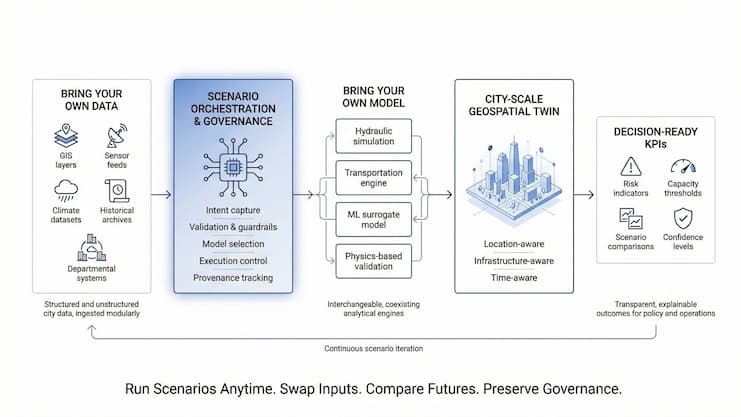
Cities already possess extensive datasets, consultants maintain specialized domain models, and researchers continue to develop experimental AI approaches. Rather than replacing these assets, SuperDNA 3D Lab can enable them to coexist and be orchestrated within a unified environment.
One of the most persistent misconceptions in urban simulation is that cities lack tools when in reality, they often have too many, ranging from GIS layers and sensor feeds to historical baselines, consultant-built hydraulic models, and university-developed AI predictors. The challenge is not capability, but orchestration.
Scenario-driven systems are increasingly addressing this constraint through a simple yet powerful principle: bring your own data, and bring your own model. The goal is not replacement, but interoperability, allowing a city-owned hydraulic model to operate alongside a machine-learning surrogate, enabling higher-fidelity engineering engines to be invoked for validation, and ingesting updated climate datasets without destabilizing the broader system.
“Flexibility is governance. When cities can introduce new data and new models without re-architecting, they gain control not just of analytical output,” noted SuperDNA 3D Lab CTO Mike Festa.
Running Scenarios Where Decisions Actually Happen
Simulations do not occur in isolation; they unfold within neighborhoods, corridors, basins, treatment plants, and across time. Running scenarios within a living geospatial representation of the city fundamentally transforms their value, shifting analysis from abstract outputs to context-driven insight.
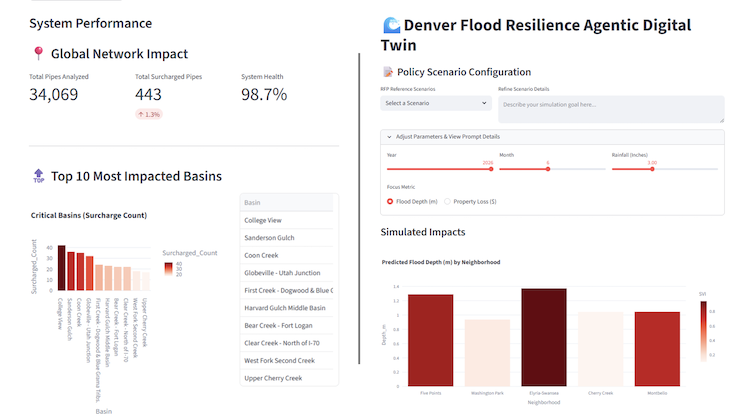
With Cesium-powered visualization and infrastructure-aligned digital twin environments such as iTwin, simulation results become location-aware, infrastructure-aware, and time-aware. Rather than relying on spreadsheets or detached dashboards, planners can identify which basins surcharge during rainfall events, which corridors flood first, which facilities approach capacity, and which neighborhoods experience disproportionate impact.
Scenario comparison becomes inherently spatial, policy discussions become grounded in real-world context, and trade-offs become immediately visible. The city is no longer an abstraction; it becomes the operating canvas for informed, data-driven decision-making.
Example: Water and Storm Scenarios
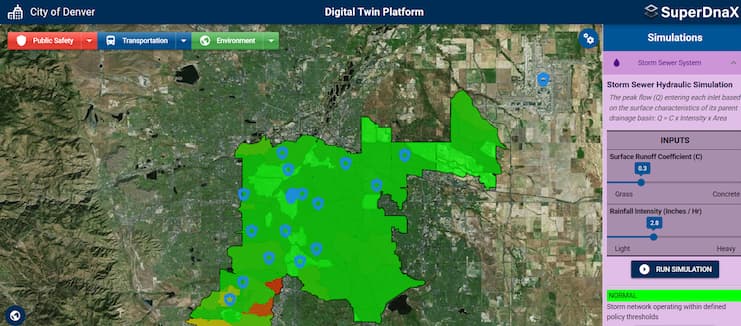
SuperDNA 3D Lab ran a demo project for stormwater management to illustrate a broader shift in how cities approach simulation. A city may run a hydraulic model for a 100-year rainfall event to guide infrastructure investments, but conditions change. Rainfall projections evolve, development alters runoff, and environmental assumptions shift.
In traditional workflows, even small changes can require rebuilding pipelines or restarting analysis. In a continuous scenario environment, cities can simply swap datasets, invoke the appropriate model, and re-run scenarios while preserving prior assumptions and results, no re-architecture required.
Stormwater, flooding, and treatment flow are just examples. The real value lies in the ability to update inputs, switch modeling approaches, and continuously evaluate outcomes as conditions evolve.
From Modeling Tools to Decision Infrastructure
The real shift is simple. Scenario simulation is moving from something cities consume once to something they own and use continuously. It is no longer a consultant deliverable or a one-time study; it becomes part of how cities and infrastructure teams make decisions every day.
When stakeholders can update data, introduce new models, and re-run scenarios as conditions change, they gain lasting control over how infrastructure is planned and managed. Scenario simulation becomes not a report, but a capability: one that supports ongoing, informed decision-making in an increasingly uncertain world.

Jatinder Kukreja is founder & CEO of SuperDNA 3D Lab.