
 by
by 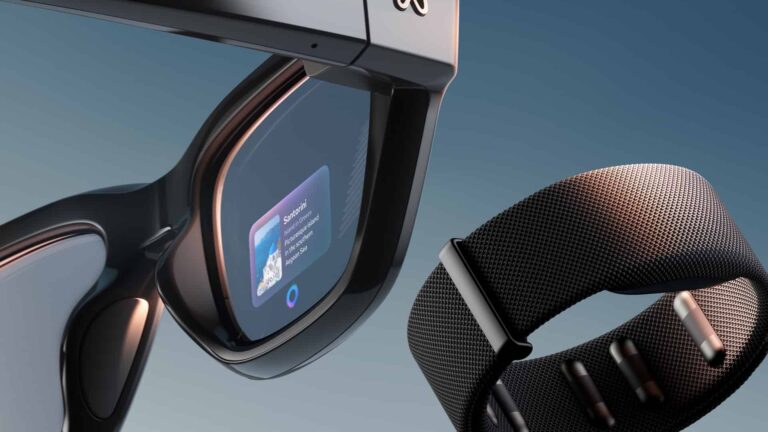
As XR evolves, it continues to branch into several form factors. For example, two overarching AR approaches are video passthrough and optical seethrough. The former is employed by Quest 3 and Apple Vision Pro, while the latter is seen in Snap Spectacles among others.
Within optical seethrough, we can further segment by functionality and UX. This ranges from non-interactive visuals (which we call “flat AR”), to fully interactive and immersive visuals (which we call “dimensional AR”). Sometimes, there’s no display at all, such as AI-smartglasses.
As these approaches continue to diverge and diversify, they often cause confusion among those outside of the XR world. To help define and contextualize this spatial spectrum, our research arm ARtillery Intelligence recently published a forecast that quantified these categories.
To highlight these definitions for AR Insider readers, we’ll break down XR classes. This moves beyond the traditional linear graph that pegs full immersion at one end (VR), augmentation at the other end (AR), and mixed reality (MR) somewhere in the middle. There’s a bit more to it.
Main Divisions
Diving in, what are the main divisions in XR? The chart below sums it up, followed by explanations of each.
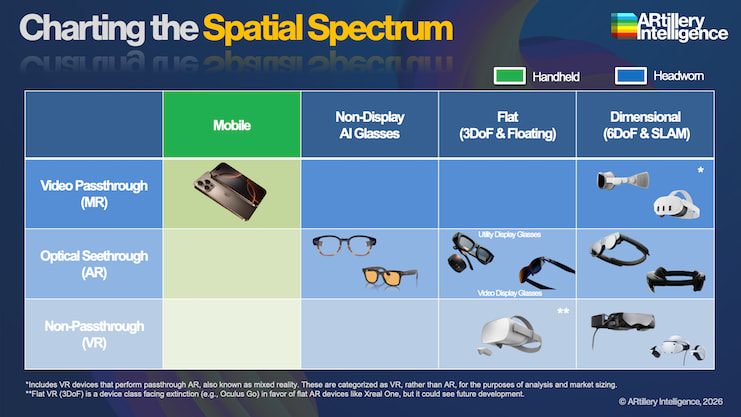
Video Passthrough (MR)
Attributes: This device class includes headsets that physically occlude surroundings but have color passthrough cameras to view the outside world from inside the device. That capability provides the foundation for augmenting physical objects and scenes with digital elements. This is also known as mixed reality.
Examples: Meta Quest 3, Apple Vision Pro.
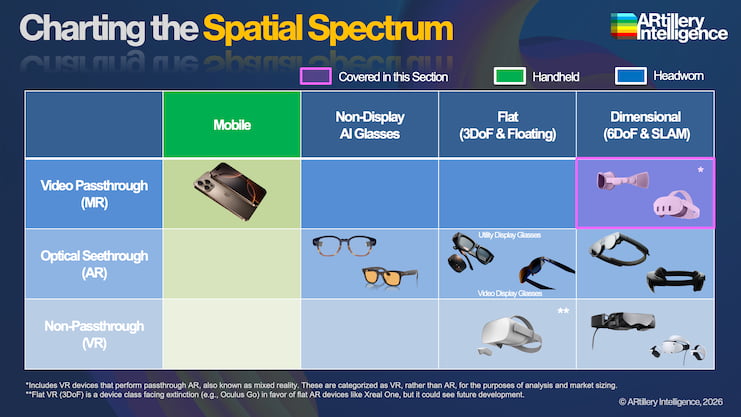
Non-Passthrough (VR)
Attributes: This includes VR headsets that may have external cameras for hand tracking, but don’t include full color HD video passthrough. Experiences are fully insular and immersive, such as gaming and entertainment. This device class continues to diminish in size as mixed reality becomes a standard in VR.
Examples: Bigscreen Beyond 2, PlayStationVR 2
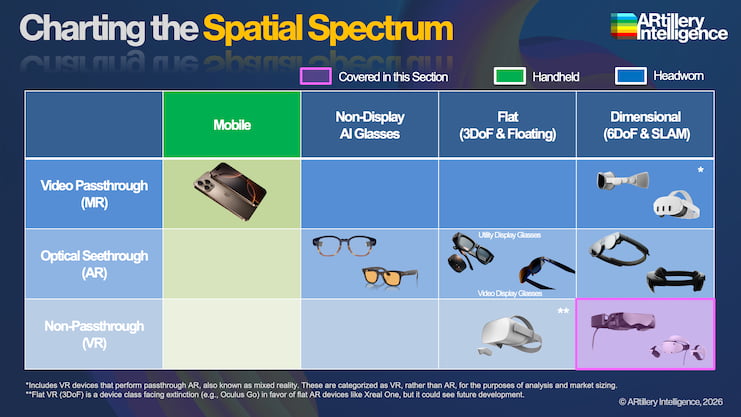
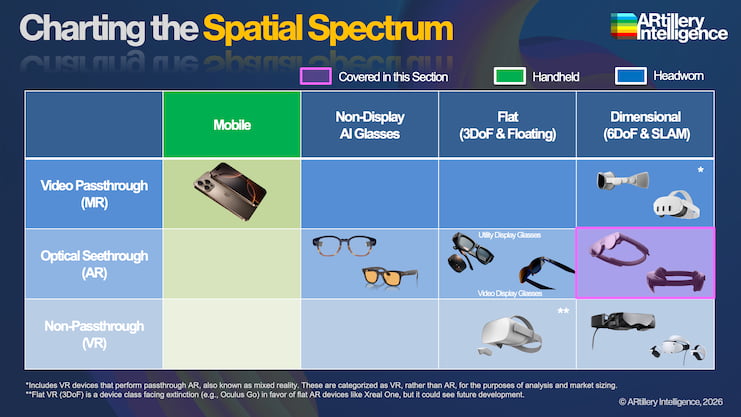
Optical Seethrough (Dimensional)
Attributes: This category includes AR devices with see-through lenses on which graphics are projected. This more advanced and “dimensional” flavor of AR features digital elements that interact with their surroundings through spatial understanding. This hallmark of dimensional AR is enabled by external cameras and software that understand and accommodate spatial geometry. Due to their technical requirements – in both hardware and software – devices in this category are generally bulkier and costlier than flat AR (below).
Examples: Snap Spectacles, Magic Leap 2
Optical Seethrough (Flat)
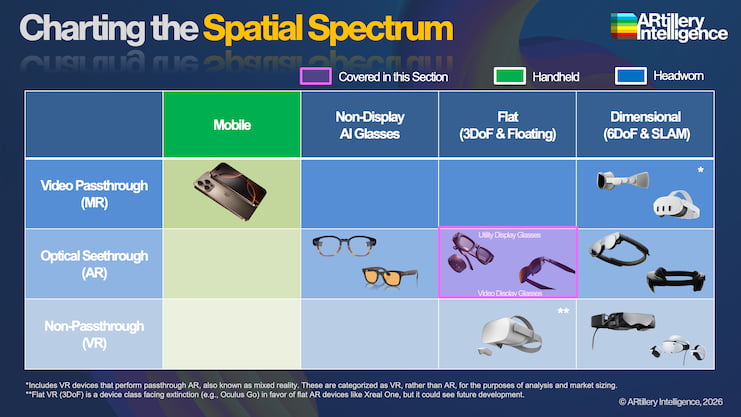
Attributes: Similar to the above category, this includes AR devices with see-through lenses on which graphics are projected and displayed. However, it differs from the above category in that graphics don’t have spatial understanding nor dimensional interaction with physical objects and spaces. They’re rather flat overlays, such as large virtual monitors/displays. But to provide additional definition, this category can be split into two subdivisions.
Video Display Glasses: These include devices like Viture Luma Pro and Xreal One that offer large field of view displays for productivity or entertainment, mirrored from any device via USB-C.
Utility Display Glasses: These include devices such as Meta Ray-Ban Display Glasses that offer small field-of-view displays for messaging, notifications, camera viewfinders or other utilities.
Non-Display AI Glasses
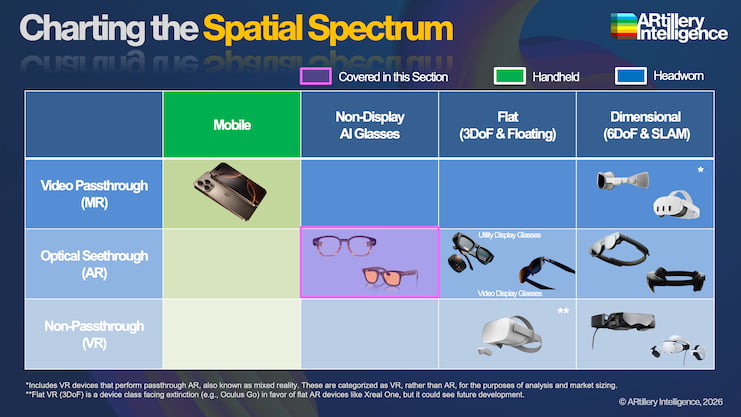
Attributes: This category includes glasses that have no display system at all. Experiential augmentation happens instead through audio. These devices generally apply AI to achieve a level of utility that compensates for the lack of visuals. For example, multimodal AI lets users speak commands (e.g., ”what am I looking at?”) and receive audible intelligence that’s based on outward cameras and visual sensors. Meanwhile, the lack of a display system enables one of AI smart glasses’ most attractive attributes: style and wearability. These glasses are often sleek and light, resembling normal eyewear or sunglasses… which makes them mainstream friendly. This is the newest AR category with the most momentum for all the above reasons.
Examples: Ray-Ban Meta Smartglasses
Mobile AR
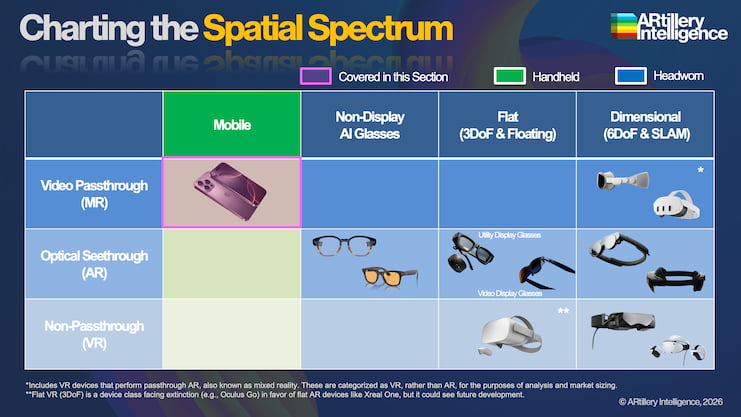
Attributes: This category is defined by AR that happens on smartphones and tablets. It’s technically a form of video passthrough AR, as it augments content from the device’s camera feed. But the biggest difference is that the form factor is handheld rather than headworn.
Moving Target
So there you have it. Though this exercise offers some definition, the spatial spectrum is a moving target. The past few years have seen devices diverge and diversify (a good thing). So as that trend continues, definitions will evolve. We’ll update this exercise as that happens.