
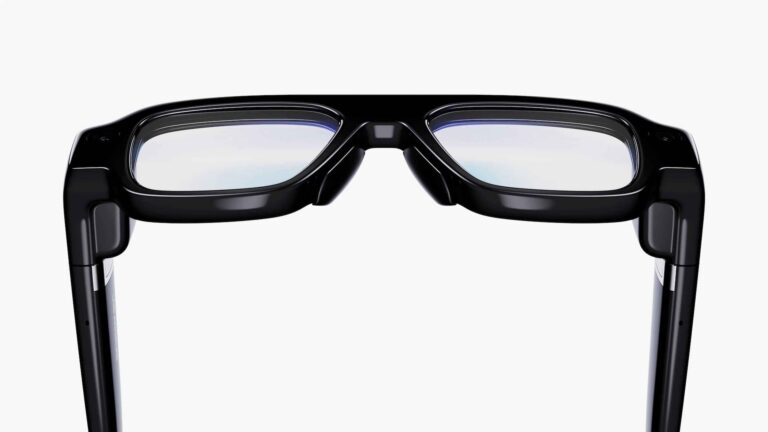

Snap showed Specs publicly in Los Angeles on September 16, after opening pre-orders in June at $2,195 in the United States, the United Kingdom, and France. For industrial work, weight matters more than the price, because it determines whether the device is worn for a single task or all day. Snap’s published specification puts Specs at 132 to 136 grams depending on frame size, a fraction of the weight of the head-mounted displays industrial teams have been issuing for years. The lenses also tint electronically in around ten seconds, which covers the walk from an indoor bay to an outdoor yard without changing eyewear.
Rendering an engineering model isn’t on that specification, and it doesn’t need to be, because that work doesn’t have to happen on the device at all.
The Tradeoff That Never Went Away
Rendering complex 3D content takes processing power. Power produces heat, and the components that supply and dissipate both add weight. That weight sits on someone’s head for the length of a shift.
Each generation of silicon shifts this trade-off. None eliminates it, because the relationship between capability, power, and heat holds at any process node. A decade of waiting for one device that renders an engineering assembly and disappears on the face has been a decade of waiting for physics to change its mind.
The useful development in the current generation is not that a device finally beat the trade-off. It’s that the display and the compute no longer have to ship in the same product.
What the Split Looks Like
Where the rendering runs is an architectural decision. Pixel streaming takes the device out of it by running and rendering the application on server hardware and sending only the finished frames.
The glasses handle display, sensing, and interaction, while the application runs and renders on external hardware the organization already operates, whether that is a workstation, an on-premises server, or its own cloud environment. The rendered images are encoded and sent to the glasses, which decode and display them. Only pixels travel. The model itself never leaves the server.
Through this approach, four constraints that have shaped enterprise XR for a decade stop applying.
1. The model stops being stripped down
When a device renders locally, the model must be reduced to fit it. Polygon counts come down, materials are simplified, and the model often must be converted into a format the device can handle. The engineer then reviews a version of the design rather than the design itself. Move the rendering to a server, and that step disappears, along with the question of whether the image on screen still matches the source data.
2. The hardware decision becomes reversible
If the glasses are a display, replacing them is a procurement exercise rather than a rebuild. This matters in a category where device lines have ended faster than enterprise refresh cycles run.
3. The data does not move
Design data stays in the environment that already holds it, under the access controls already written for it. What reaches the glasses are rendered images of the model rather than the underlying geometry itself. In aerospace, defense, and automotive programs, this is usually the first question asked, and it often determines whether a pilot happens at all.
4. Anything the server runs can reach the glasses
A rendering application and an AI service can run on the same infrastructure and be streamed to the same pair of glasses. Combining spatial content with AI context turns into a question of what gets deployed, rather than what the frame can carry.
Where this already happens
Streamed XR has been in industrial use for years. In automotive, a full vehicle can be reviewed at scale before a prototype exists, with reviewers walking around it and sitting inside it to check reach and sightlines. In manufacturing, a line can be laid out and checked in the hall it will occupy, and assembly steps can appear as overlays on the machine an operator is working on. Training can run on the same full-detail model engineering works from rather than a simplified version built to fit a device. Light glasses like Specs extend that to more use cases and more of the working day.
With a streaming infrastructure in place, applications and devices can change around it, which is what lets the range of work keep growing without anything underneath being rebuilt.
Choosing the device
The practical advice is to stop specifying the device as though it were the computer. The device can then be chosen like any other piece of equipment, for the job and the conditions it will be used in. Glasses light enough to stay on through a full working day open up use cases that a session-length headset never could. On top of that, they can handle serious 3D work precisely, because they no longer have to render it.
Glasses like these come out of consumer development rather than enterprise procurement, which means enterprises can now buy into a cycle that moves considerably faster than enterprise hardware ever did. And where rapidly changing hardware used to mean rebuilding, it now means swapping a display and carrying on.

Florian Haspinger
AR Insider Guest Author