
 by
Meta announced Q3 earnings last week, including $64.6 billion in revenue, up 26 percent year-over-year. Growth continues to be driven by AI-fueled ad targeting. This is a powerful revenue driver, but is offset by Meta’s CapEx spending to build towards an agentic future.
Resting under those high-level results, Meta Reality Labs’ (MRL) revenue was $443 million. This was down 5.7 percent year-over-year, and up 3 percent quarter-over-quarter. But as it goes with MRL, the top line was overshadowed by bottom-line losses, to the tune of $4.13 billion in Q3.
Sticking with the top line, MRL revenue was driven by Ray-Ban Meta Smartglasses (RMS), which grew 20 percent year-over-year according to EssilorLuxottica’s Q3 earnings. For Meta, the familiar earnings narrative is that smart glasses are the growth engine, while VR sales flatten or decline.
There’s much to say about all these dynamics (more in a bit). But our main question is how Q3 revenue translates to hardware unit sales. This is an exercise we’ve done every quarter for several years (see last quarter), which helps inform broader VR momentum and market sizing.
Reverse Engineering
Diving in, MRL’s top-line revenue was $443 million in Q3, as noted. As done in the past, we can use this to reverse-engineer unit sales. This exercise gets harder every year due to more revenue sources. It’s not just one flagship Quest headset anymore… but several devices in the mix.
To that end, we’ve estimated Meta Reality Labs’ revenue share breakdowns based on several signals we’re tracking. You can see those estimates below. In this hardware-centric exercise, we’ll focus on the last 7 bullets, which account for 92 percent of MRL revenue.
- VR software (game & app sales): 8 percent*
- Quest 3: 14 percent
- Quest 3s: 12 percent
- Meta Ray-Ban Display Glasses: 2 percent
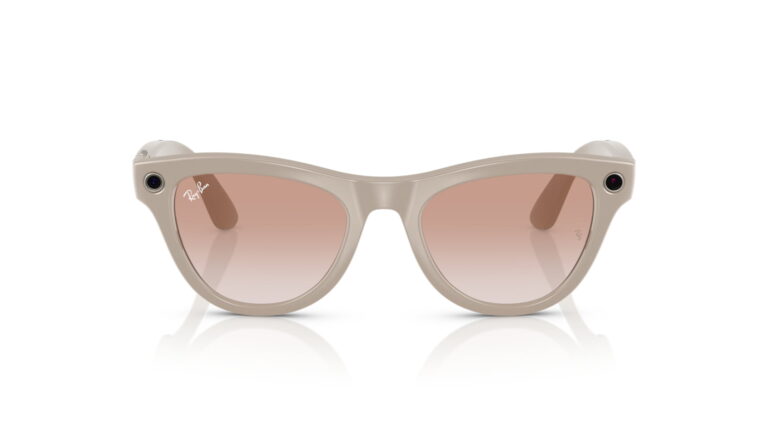
- Ray-Ban Meta Smart Glasses: 45 percent
- Meta Glasses (Adventurer & Fury Models): 5 percent
- Oakley Vanguard: 6 percent
- Oakley HSTN: 8 Percent
(percentages apply to revenue shares in dollars, not units)
*This figure represents the Oculus Store’s gross revenue, before developer payouts when applicable, which are usually 70 percent after taxes.
Per-Device Unit Sales
Quest 3
Based on the above revenue shares, Quest 3’s estimated quarterly revenue was $62.02 million. Considering an average unit price of $499, Meta sold an estimated 124,289 units during the quarter.
Quest 3s
Based on the above revenue shares, Quest 3s’ estimated quarterly revenue was $53.16 million. Considering an average unit price of $329, Meta sold an estimated 161,581 units during the quarter.
Meta Ray-Ban Display Glasses (MRD)
Based on the above revenue shares, MRD estimated quarterly revenue was $8.86 million. Considering an average unit price of $799 (and a revenue split with EssilorLuxottica), an estimated 14,791 units were sold during the quarter.
Ray-Ban Meta Smart Glasses (RMS)
Based on the above revenue shares, RMS estimated quarterly revenue was $199.35 million. Considering an average unit price of $379 (and a revenue split with EssilorLuxottica), an estimated 1,049,211 units were sold during the quarter.
Meta Glasses (Adventurer & Fury Models)
Based on the above revenue shares, Meta Glasses estimated quarterly revenue was $22.15 million. Considering an average unit price of $320 (and a revenue split with EssilorLuxottica), an estimated 134,242 units were sold during the quarter.
Oakley Vanguard
Based on the above revenue shares, Vanguard’s estimated quarterly revenue was $26.58 million. Considering an average unit price of $499 (and a revenue split with EssilorLuxottica), an estimated 106,320 units were sold during the quarter.
Oakley HSTN
Based on the above revenue shares, HSTN’s estimated quarterly revenue was $35.44 million. Considering an average unit price of $429 (and a revenue split with EssilorLuxottica), an estimated 164,837 units were sold during the quarter.
Grand Total
Adding up all devices, we get an estimated 1,755,271 units sold in Q3. That consists of 1,469,401 smart glasses and 285,869 VR headsets.
So there you have it. Of course, much of this exercise is based on the above-estimated revenue shares across Meta Reality Labs’ commercial products. Those share estimates are educated but up for debate: anyone can adjust them and run the model accordingly.
The Headline
Stepping back, smart glasses are growing rapidly, but offset by declines in VR headsets. That offset is impactful for two reasons. First, VR headsets stimulate additional Meta revenue through games and apps. Second, they don’t involve a revenue split as smart glasses do in Meta’s case.
Regardless of those issues, the headline is that AI glasses are the growth engine. Meta will continue to internalize these demand signals and course-correct its roadmap accordingly. Today, that means non-display AI glasses (RMS) and, to a lesser extent, flat-AR display glasses (MRD).
This is Meta’s message to the market as MRL endures massive losses. The division remains massively in the red with $4.13 billion in Q3 losses. On the bright side, losses have narrowed from Q2, as Meta projected would happen at the time. This trend could continue.
Wall Street seems to tolerate that narrative, as Meta shifts spending to massive CapEx investment in AI infrastructure. Though there’s skepticism on the street about such high CapEx among tech giants, there’s defensibility in owning the AI stack (Meta) versus outsourcing it (Apple).
Mark Zuckerberg learned this lesson the hard way throughout the smartphone era. By not owning or controlling the user touchpoint – ceding positioning to Apple and Google – Facebook suffered. MRL was created to own the XR stack, and a similar approach is now in play for AI.
The bad news is that applying a full-stack development approach to two major product areas is costly. So MRL will continue to get budget pulled away for AI investment. But the good news is that headsets and wearables could eventually be the hardware layer of that full-stack AI puzzle.