
 by
Welcome back to our weekly roundup of happenings from XR and AI realms. Let’s dive in…
The Lede
AI Stock Sell-Off Sends Nasdaq Down 5.5 Percent. U.S. technology stocks suffered heavy losses Thursday, November 5, as investors reassessed AI infrastructure spending and the prospects for semiconductor companies. The Nasdaq Composite fell 5.5 percent, the S&P 500 declined 4.4 percent, and the Dow Jones Industrial Average lost 3.4 percent. The Philadelphia Semiconductor Index dropped 12.2 percent, its largest one-day decline since April 2025. Reuters attributed the sell-off partly to disappointing Qualcomm earnings and concerns that a newly Democratic-controlled Congress could restrict data-center construction. The Nasdaq entered correction territory, falling at least 10 percent from its previous closing high. The declines reflected growing investor concern about the cost and pace of AI infrastructure expansion. As of this writing, there’s a moderate rebound underway as dip buyers return to the AI trade
Feeling Spatial
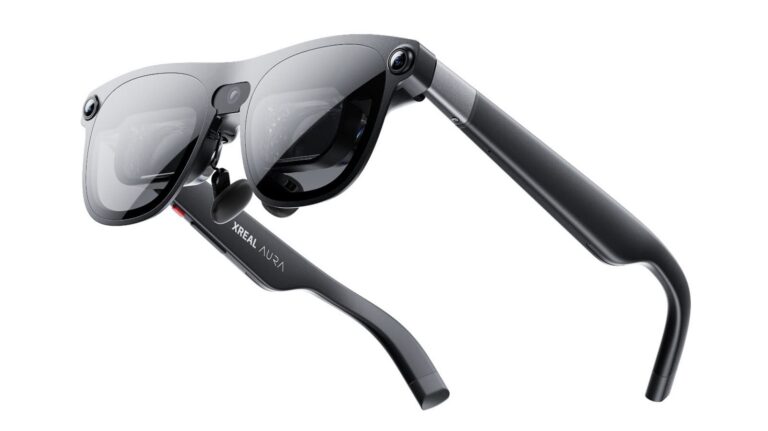
XREAL Launches Aura AR Glasses With Google Android XR. XREAL officially launched its Android XR-powered Aura glasses, offering introductory discounts of $180 to $200 through December. The 12GB/256GB model costs $1,099, down from $1,279, while the 16GB/512GB version is $1,299, down from $1,499. Developed with Google and Qualcomm, Aura features transparent displays, Gemini AI integration, and a separate computing puck that handles processing. Shipments are scheduled to begin in mid-November in the United States, Canada, Japan, and South Korea. The glasses support spatial computing applications, including virtual screens, immersive entertainment, and AI assistance. New content includes an augmented reality version of Fallout: Factions, while support from the Godot game engine expands development options for independent creators building applications for the Android XR platform | The Ghost Howls
Schell Games lays off 49 in second round of cuts. Schell Games, the Pittsburgh studio behind the I Expect You To Die series and Among Us 3D, laid off 49 employees on October 30, about 40 percent of its workforce, in cuts across engineering, art, design, production and other roles. It was the studio’s second round of layoffs in 2026, following an August cut of about 10 percent — the first layoffs in the company’s 24-year history. Schell said the cuts were necessary “to ensure a sustainable future for our studio,” and its next release, the mixed-reality puzzler Dragon Grove, remains slated for spring 2027. The cuts continue a difficult year for VR developers, with layoffs at Mighty Coconut, Survios and Camouflaj and closures at Sanzaru, Twisted Pixel and Polyarc. | UploadVR
The AI Desk
Geoffrey Hinton: humanity might have been better off without AI. Geoffrey Hinton, the 78-year-old Nobel laureate and University of Toronto professor emeritus whose neural-network research underpins modern AI, told The Guardian that humanity might have been better off never developing the technology. In an interview published November 3, ahead of a screening of the documentary AI: Probably Nothing to Worry About, he predicted a “Chernobyl”-scale incident this year or next — an AI-enabled attack that knocks out power grids or paralyzes financial systems for about a week — and said the next decade will show whether AI brings “radical abundance” or mass unemployment and social division. He said he does not trust OpenAI chief Sam Altman “at all,” and that Altman, Mark Zuckerberg and Elon Musk understand the risks but “don’t give a shit” because “they’d rather have the money.” | The Guardian
Spatial Audio
This column has a companion, the AI/XR Podcast, hosted by its author, Charlie Fink; Ted Schilowitz, former studio executive and futurist for Paramount and Fox; and Rony Abovitz, founder of Magic Leap and Synthbee AI.
Last week’s guest was Roy Price, former head of Amazon Studios and founder of streaming app N1BW (see episode below). Our guest this week is analyst Karl Guttag, a computing pioneer who designed chips for Texas Instruments before turning his deep well of understanding to XR. Episodes drop on Fridays, and you can find them on podcasting platforms Spotify, iTunes, and YouTube.
Cinematic Corner
Editor’s note: This section previews happenings from the Cinematic AI universe, covered in full on Charlie Fink’s Substack, Cinematic AI Pics, News & Tips; as well as his podcast, The Pop Fink Podcast (coming soon and previewed below).
Kling AI Raises Nearly $3 Billion in New Financing: Kuaishou Technology announced October 30 that its Beijing Kling subsidiary completed a financing round of approximately 19.8 billion yuan, equivalent to $2.98 billion. Reuters reported that Kuaishou will retain two-thirds of the equity and 52.45 percent of voting rights through its Lucky Labs holding company. The transaction follows a $2.8 billion financing round in July, when Kling was valued at $15 billion before the investment. New investors included entities associated with Kingdee International and semiconductor company MetaX. Kuaishou did not disclose how the proceeds would be spent. Bloomberg previously reported that Kling was considering an initial public offering in 2027. Kling competes with video generation systems from OpenAI, Google and ByteDance | Reuters
Grimes joins the cast of Gods Don’t Give Gifts. Pop musician Grimes (Claire Boucher) will make her feature film debut in Gods Don’t Give Gifts, Fable announced November 5, lending her likeness and her real voice to the fully AI-generated sci-fi anthology directed by Zack London, who works as Gossip Goblin, and produced by Fable chief Edward Saatchi. Grimes plays Zayinth Alda, a disaffected aristocrat, in one of four interconnected stories set on Niiro Cradle, a world where bodies are disposable and consciousness is commoditized; she licensed her likeness for free and declined payment. The R-rated film is billed as the first fully AI-generated feature to receive a US theatrical release and opens December 4. Fable plans to submit it for Best Animated Feature at the Academy Awards, whose rules state that AI use neither helps nor harms a film’s chances. | The Verge
Sand.ai raises $200 million for generative video models. Beijing-based Sand.ai closed a $200 million Series A+ round, announced November 5, co-led by CoStone Capital and Wangsu Science & Technology, lifting its valuation above $1 billion. It is the company’s third financing round of 2026, bringing its total raised over ten months to about $300 million. Founded in 2024 by Cao Yue, a former principal researcher at Microsoft Research Asia and co-author of the Swin Transformer architecture, Sand.ai develops the MAGI family of generative video models; its open-source MAGI-2 Preview is a 114-billion-parameter mixture-of-experts model, and its VidMuse creation service passed $10 million in annualized recurring revenue within two months of launch. The company plans to spend the proceeds on model research, training and inference infrastructure, product development and international expansion, ahead of a full MAGI-2 release. | TechNode
Chroma Awards Opens Submissions for Second Season With $450,000 in Prizes and Travel Benefits. The AI media competition incubated by ElevenLabs opened October 19, offering more than $450,000 in cash prizes and travel benefits. Organizers report over 6,500 entries from more than 5,500 creators in last year’s competition. Categories span film and television, advertising, music videos, games, and behind-the-scenes productions, including a microdrama category sponsored by ReelShort. Participants can access more than $1 million in free tool trials and promotions. Entry is free. Submissions close January 7, 2027, with winners announced February 11. Submit here.
Stay Tuned…
Many of the items and topics above will be fodder for The Pop Fink Podcast. Hosted by the author of this column and former CAA, NBC & HP exec, Joanna Popper, it will be coming soon to Spotify, iTunes, and YouTube.

Charlie Fink
AR Insider Contributor