
 by
One health indicator in any tech sector is the venture funding that flows into it. XR is no exception, as its venture-funding fluctuations – both up and down – map to its general health. A historical sequence of XR industry ups and downs has tracked closely with its funding inflows.
These events over the past decade include the XR industry’s circa-2017 hype cycle, subsequent correction, quick rebound, metaverse boom/bust, Covid software boom/bust, and the more recent rise of AI. XR funding throughout this period maps closely to the macro-environment.
So where are we now? After a few years of declines – mostly due to the hangover from circa-2021 “metaverse mania,” XR venture funding reached $3.53 billion in 2025 – a 117 percent year-over-year jump. Meanwhile, 2026 year-to-date funding has mostly sustained this momentum.
What’s driving this growth? This is the topic of a recent report from our research arm, ARtillery Intelligence. It joins our excerpt series, continuing in this edition with a drill-down into funding levels in XR product categories. Which spatial segments are attracting the most investment?
Expensive Endeavor
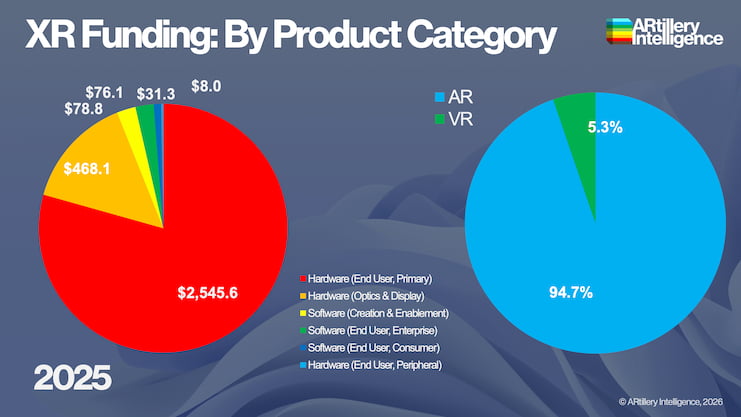
Starting at a high level, how does XR funding break down by AR and VR? The former led with a meaningful share, 94.7%, as shown below. This is because the largest funding events of the year were for AR products, including mega-rounds for Anduril, Xpanceo, and VITURE.
One reason for AR’s dominance is a greater sense of commercial market size. This aligns with a broader trend in the XR world where AR gains traction and overall interest – including smart glasses – while VR declines. This can be seen in Meta’s earnings, among other places.
Another reason is that AR is more capital intensive – often in earlier lifecycle stages than VR. Using the examples above, Anduril is pioneering technical breakthroughs in battlefield tech – an expensive endeavor. And Xpanceo’s smart contact lenses involve capital-intensive R&D.
Drilling Down
Drilling down from the broader demarcation of AR and VR, how does XR funding break down by product category? Primary end-user hardware dominated XR funding. This includes end-user devices such as headsets. The reason is similar to that examined above: outlier funding rounds.
For example, this is the category occupied by Anduril’s massive funding round in 2025. The remainder of funding in this category was made up of smaller but still significant funding rounds for Vuzix, Pimax, Varjo, and Rokid. Each of these players offers user-facing XR hardware.
The second biggest category was optics & display hardware. This is a large and important category, as it’s a key underlying tech that advances the momentous smart glasses category. But the category’s positioning in 2025 funding was more directly driven by funding for Xpanceo.
Risk Appetite
Another way to segment XR funding is by investment stage. Here, XR follows broader patterns in tech sector investing. For example, post-Series C funding leads, followed by Series A, B, and C, while the lowest funding levels are seen in early stages such as seed and crowdfunding.
One simple explanation is that later-stage rounds involve larger deals, as companies are larger and require greater capital investment to operate and grow. In XR, we’ve also seen a broader preference for later-stage rounds due to investors’ risk appetite in the current environment.
Sticking with that last point, the still-resonant hangover from the metaverse boom/bust cycle causes investors to be more cautious. In that light, they have gravitated towards later rounds, when companies have been validated and where KPIs and financial metrics are more tangible.
We’ll pause there and pick things up in the next installment with more analysis around the XR funding environment. Meanwhile, check out the full report for more color.