
 by
by 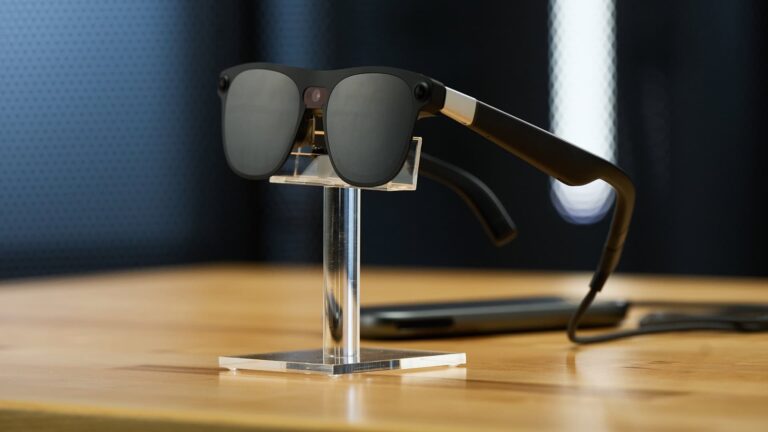
As we approach a new year, it’s time for our annual ritual of synthesizing the lessons from the past twelve months and formulating the outlook for the next twelve. 2025 was an incremental year for spatial computing, which continues a gradual uphill ascent toward mainstream traction.
2025 highlights include XR’s ongoing convergence with AI, inflections in non-display AI glasses, the rise of video display glasses, and the unveiling of the long-awaited Meta Ray-Ban Display glasses. Meanwhile, roadmap signals emerged from players ranging from Snap to Apple.
All these approaches – video passthrough AR, optical seethrough AR, and non-display smartglasses – represent form-factor divergence and diversification. That’s a good thing, as XR should include varied formats that are purpose-built and use-case-driven – a key trend in 2025.
With that backdrop, what will 2026 look like in spatial computing? Aligned with the broader predictions of our research arm, ARtillery Intelligence, we’ve devised 5 predictions for 2026. We’ll break them down weekly, continuing here with #4: Android XR Unlocks Spatial Scale.
Prediction 1: AI’s Bubble Bursts… But the Value to XR Lasts
Prediction 2: Your Face is the Next AI Battleground
Prediction 3: 2026 Sets the Table for 2027 Inflection
Prediction 4: Android XR Unlocks Spatial Scale
Prediction 5: Video Display Glasses Pull Ahead
History Repeats
Picking up where the previous prediction left off, Android XR will unlock scale throughout the spatial computing sector. It could do for XR what Android did for smartphones over the past 20 years. That includes boosting healthy platform competition among sparring tech giants.
The other important Android XR effect is lowering barriers to bring devices to market. Put another way, Android XR takes care of the OS, thereby freeing up OEMs to focus on hardware and other aspects of their go-to-market strategies – just like Android does in the smartphone world.
Similarly, it will bring standardization to XR in ways that improve UX. For example, best-of-breed mechanics will permeate Android XR devices, such as user interfaces and interactions. In that sense, developers – just like OEMs noted above – can focus on what they do best.
Android XR will also serve developers with greater scale when it comes to content and app distribution. That will occur through a formal app marketplace – an offshoot of Google Play – and APKs for developers to distribute software through sideloading… again, like Android.
Horse Race
Altogether, Android XR will bring more functionality and optionality to XR – and it will do so on the stable foundation of the familiar Android operating system. That last part is repeated often by Google: “If you’re an Android developer, you’re already an Android XR developer.”
Meanwhile, all the above evokes the two-horse race in the mobile world, where Apple is the more structured and vertically-integrated player; while Android is the more open and distributed player. However, there’s one difference between the XR and smartphone landscapes.
That difference is the number of players. Though it will resemble a horse race, the XR competitive field won’t be two horses. Rather, several platforms will compete, from Snap to Meta to Apple to the broader constellation of Android XR. Several market moves point to that reality.
Though this means market fragmentation, which has disadvantages in early days when the addressable market is relatively narrow – it will have long-run advantages in the competition it seeds. That in turn drives rigor among all these players to innovate and drive costs down.
Concrete Prediction
To boil all the above down to a quantifiable prediction for 2026, we project at least 5 Android XR devices announced or launched next year. These will include flat-AR display glasses from Samsung and Xreal, and non-display AI glasses from Warby Parker and Gentle Monster.
The already-released Samsung Galaxy XR (dimensional AR) will meanwhile reach unit sales of 125,000 in 2026. For more details on all these XR device classes and how the Android XR universe maps to those formats, check out our recent breakdown of the spatial spectrum.
We’ll pause there and circle back next week with another 2026 prediction. Meanwhile, see the full report. And to calibrate our aptitude and track record in projecting XR market outcomes, see our recent article evaluating last year’s predictions.