
 by
by 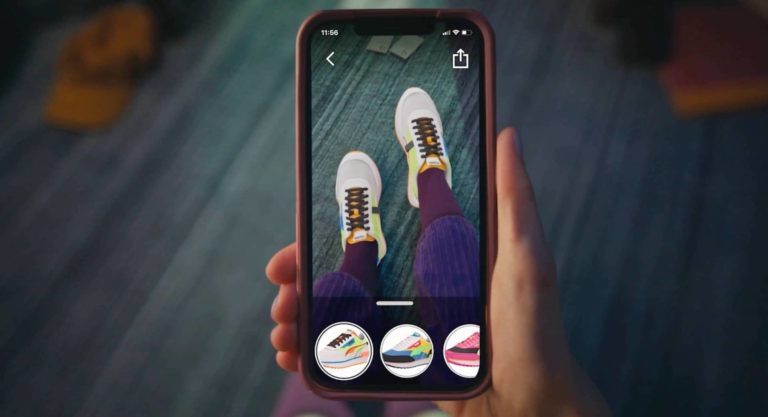
Immersive marketing continues to be an opportune, yet still challenged, segment. Sitting at the intersection of brand marketing and spatial computing, it includes things like sponsored AR lenses that let consumers interact and engage with brands, or virtually try on products.
Driving immersive marketing are a few key elements. Lens creation software arms brands and developers with low-code tools to author AR experiences. Meanwhile, networks like Snapchat and TikTok likewise offer the ability to amplify lenses throughout their social graphs.
There’s also a real business case, which can be seen in the performance metrics around AR campaigns. And though the future of AR is headworn, we’re mostly talking about AR marketing on smartphones. That’s where the scale lies… and brand marketers are all about scale.
This is the topic of a recent report from our research arm, ARtillery Intelligence, including ecosystem analysis and case studies from real AR marketing campaigns. The report joins our excerpt series, continuing in this installment with a look at AR marketing’s biggest challenges.
Quality & Quantity
Despite AR marketing’s benefits, explored in the previous installment of this series, it isn’t without challenges. For one, spending growth has slowed. After ramping up due to brand marketer excitement during the period we call “metaverse mania” (~2020-2022), a retraction followed,
After brands jumped on the bandwagon, many then shunned the category as the metaverse proved to be intangible. In reality, the excitement around the metaverse wasn’t invalid but simply ahead of its time. Either way, the damage was done to adjacent segments like AR marketing.
Another challenge is that most immersive marketing campaigns happen in and around mobile AR. Though it scales in terms of reach and installed base, it doesn’t represent AR’s best self. Its true potential lies with the immersion, interactivity, and advantages of AR glasses.
Though there are meaningful market developments and recent inflections in AR glasses – most of them related to low-immersion smart glasses – the category still doesn’t offer the scale and reach that smartphones do. And that’s the thing with brand marketers… they’re all about reach.
So it’s a bit of a double-edged sword. Mobile AR offers the prerequisite scale for brand marketing, but it doesn’t offer the most immersive format and UX impact. The hope is that AR glasses will someday reach the point when they offer both scale (quantity) and interactivity (quality).
Opportunity Gaps
Continuing with the theme of AR’s headwinds, there are other factors that aren’t necessarily challenges and shortcomings, but areas that need to be developed. For example, one key ingredient for AR Marketing is 3D models. These are used in areas such as virtual try-ons.
This requires graphical elements such as CAD files and a certain degree of production rigor. Among other things, it involves large-file 3D models and interaction design. This presents an opportunity for platforms that can streamline 3D asset creation, management, and distribution.
The good news is that such tools are increasingly baked into free AR platforms such as Snap Lens Studio. And several orbiting software players continue to innovate around 3D model creation, eCommerce integrations, and other puzzle pieces in the immersive marketing stack.
We’ll pause there and circle back in the next installments of this series with a deeper dive into challenges facing immersive marketing, and corresponding opportunity gaps. Later installments will show rather than tell with campaign case studies. Meanwhile, check out the full report.