
Welcome back to our weekly roundup of happenings from XR and AI realms. Let’s dive in…
The Lede
Google I/O 2026 is next week. The event comes after Google’s Android Show, where the company laid out Gemini Intelligence features for Android, including multistep tasks across apps, form filling, web browsing, dictation, and natural language widget creation. Google’s return to smart glasses looks very different from the original Google Glass a decade ago. Google is expected to use Google I/O to lay out an ecosystem strategy built around Android XR, Gemini, and multiple hardware partners rather than a single Google-branded device. Expected partners include Warby Parker and Gentle Monster, while Samsung is preparing Android XR glasses of its own. AI audio assistants, cameras, translation, and contextual computing are finally becoming practical in lightweight eyewear.
Feeling Spatial
Samsung may show its first smart glasses at a reported Galaxy Unpacked event in London on July 22. Road to VR says the device is expected to run Google’s Android XR and may involve eyewear brand Gentle Monster. The first version is expected to resemble Ray Ban Meta and Oakley Meta glasses, with microphones, camera, speakers, and onboard AI, but no display. That makes Samsung part of the first Android XR wave, alongside Google’s partnerships with Gentle Monster, Warby Parker, and Kering. The story belongs in the smart glasses race, where AI audio glasses are becoming the entry product.
Meta Immersive Web SDK. Meta updated its open source Immersive Web SDK with an AI-assisted workflow for building WebXR experiences. One of the biggest obstacles to making VR content is game engines. The tools for spatial content creation have not yet felt the benefit of AI, but this toolkit, which works with coding assistants including Claude Code, Cursor, GitHub Copilot, and Codex, is meant to help developers build browser-based VR without dealing directly with low-level systems like physics, hand tracking, locomotion, grab interactions, and spatial UI.
Meta Connect will return September 23 and 24 at the company’s Menlo Park campus, with keynotes streamed online. Meta says the event will focus on VR, wearables, metaverse, and AI. Mark Zuckerberg teased what appears to be another pair of smart glasses, obscured in a social post. Road to VR notes the event comes after a rough year for Meta’s XR business, including reorganizations, layoffs, and studio closures, while the company has shifted more attention to smart glasses. For the column, Connect is the next major checkpoint for Meta’s XR strategy and its move from headsets toward wearable AI.
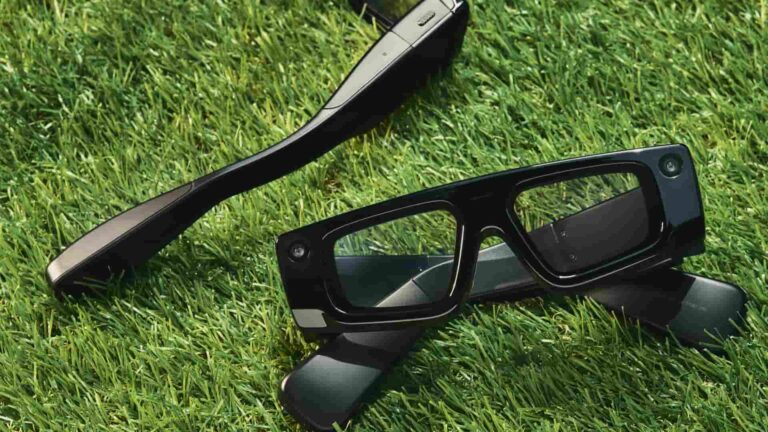
Snap CEO Evan Spiegel will give the opening keynote at AWE USA 2026 in Long Beach on June 16. The incredible ambition of Snap Spectacles, which will soon be the only see-through AR glasses, will be on stage where Snap CEO and co-founder Evan Spiegel is expected to unveil the release date and price of the new AR glasses. Snap has spun out Specs Inc. to house its AR business, reportedly to focus the unit and raise capital while containing risk. The path has been uneven, with a senior AR executive leaving and Snap confirming layoffs on the parent company side.
The AI Desk
Google announced Gemini Intelligence features for Android that move its assistant closer to an agent running across the phone. Users will be able to press the power button and ask Gemini to complete multistep tasks, such as copying a grocery list from notes into a shopping app, with final confirmation before checkout. Gemini will also browse the web, fill out forms, summarize pages in Chrome, and come to Gboard through a dictation feature called Rambler. Google is also letting users create Android widgets by describing them in natural language. The first rollout goes to recent Pixel and Samsung Galaxy devices this summer.
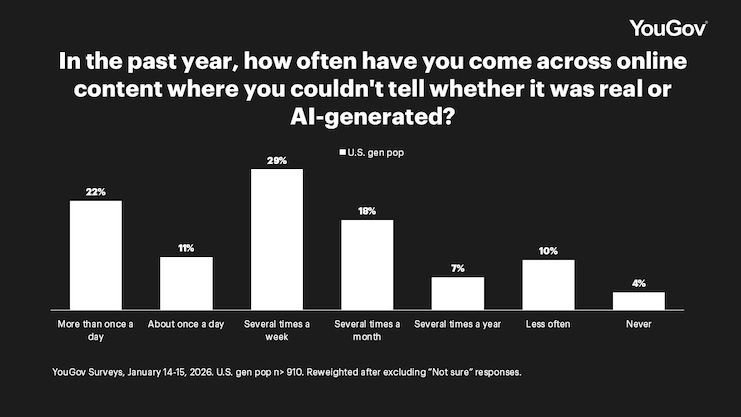
New YouGov data commissioned by ZINE suggests Americans increasingly treat online content with suspicion as AI-generated media spreads across the internet. Sixty-one percent say they encounter content they cannot distinguish as real or synthetic multiple times a week, including one-third who face that uncertainty daily. While 59% claim confidence in spotting AI-generated content, most describe themselves as only “somewhat” confident. Americans are now six times more likely to assume questionable content is fake than real. Generational and political divides are also widening. Boomers report more exposure to ambiguous content, while Gen Z reports greater confidence in detection. Liberals are more likely to verify questionable material, while conservatives more often ignore it or dismiss it as fake.
Netflix is staffing a new internal unit called INKubator, or INK, focused on generative AI animation. The Verge found job listings for producers, software engineers, CG artists, and a head of technology. The unit appears focused first on short-form animated content and specials using experimental AI native production pipelines, with job language pointing to longer form ambitions later. Netflix has not announced the studio publicly. The story follows its acquisition of Ben Affleck’s AI startup InterPositive, which The Verge describes as more post-production focused. The column angle is Netflix quietly building an AI animation pipeline inside the studio system.
Flick raised a $6 million seed round from True Ventures, GV, Y Combinator, Lightspeed, Formosa Capital, Pioneer Fund, Olive Tree Capital, N1, and angels. The AI native filmmaking platform was founded by filmmaker Zoey Zhang and Instagram Stories founding engineer Ray Wang. The company says it is building tools for cinematic control, nonlinear workflows, and iteration rather than simple text-to-video generation. Flick is also launching a filmmaker residency with more than 10 short AI native films shown at Cinequest, MIT, and the Omni AI Film Festival. Treat this as a funding item, but note the source is a press release.
Critterz, OpenAI’s AI-assisted animated feature created by OpenAI’s Chad Nelson and written by Paddington in Peru writers, is being launched in the Cannes market by AGC Studios. Variety reports that AI animated feature Critterz is entering the Cannes market as one of the first serious attempts to package an AI-assisted animated film for global distribution. The project comes from OpenAI creative technologist Chad Nelson, Native Foreign, and Vertigo Films, with AGC Studios handling sales. The screenplay is by Paddington in Peru writers James Lamont and Jon Foster. Variety also reports that Vertigo and Federation Studios are launching a new AI native production company called Amersia alongside a production system called Woven, which was used on the film. The larger story is not the movie itself, but the emergence of AI native production infrastructure aimed directly at mainstream feature animation.
Cinematic Corner
Watch the last three episodes of Linda’s Last Podcast below. Produced by the author of this column, you can see the series archive and subscribe on YouTube.
Spatial Audio
This column has a companion, the AI/XR Podcast, hosted by its author, Charlie Fink, and Ted Schilowitz, former studio executive and futurist for Paramount and Fox, and Rony Abovitz, founder of Magic Leap and Synthbee AI.
Our latest guest was creative technologist, inventor, investor, and co-founder of Keyhole, which became Google Earth, Dave Lorenzini (see episode below). Our next guest is Joshua Pantony, founder and CEO of Booted AI (finance AI).
Episodes drop on Tuesdays, and you can find them on podcasting platforms Spotify, iTunes, and YouTube.
 Charlie Fink is the producer and co-host of the AIXR Podcast and teaches at Chapman University and ASU. Fink is the producer of the vertical gen AI social media series, “Linda’s Last Podcast” (2026) and serves as CEO of Cinemation.AI, an AI animation studio he co-founded with film director Rob Minkoff, whose vertical anime series, Speed Queen, is in pre-production. He is the author of the critically acclaimed AR-enabled books Charlie Fink’s Metaverse (2017), Convergence, Or How the World Will Be Painted With Data (2019), and the upcoming AI, The End of Hollywood, and What Comes Next.
Header image credit: Tingey Injury Law Firm on Unsplash