
 by
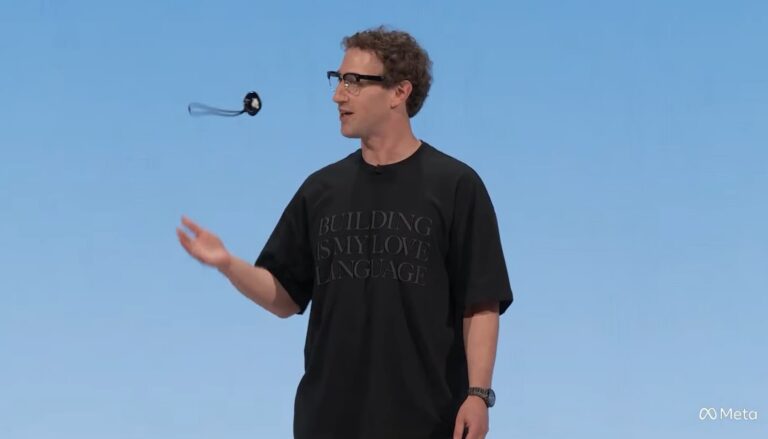

Meta has been behaving differently lately. From the way it structures its product reveals to the background stage setup, all the way to body language and Zuckerberg’s custom T-shirts. Nothing is accidental, and the story that Meta is trying to tell is that it’s got its confidence back.
This boastful attitude is something I have not seen since the early Oculus Connect days. During the previous two Meta Connects, the energy felt defensive, and it appeared like Mark Zuckerberg and Andrew Bosworth were on stage trying to prove something. By comparison, this year’s keynotes were much more assertive and even a bit nonchalant.
Part of it is undoubtedly thanks to keynote strategists and creative partners. Meta usually works with Artemis Ward, so perhaps some of the credit should go to the agency. Things like body language and demeanor, however, are hard to script. Here, the recent Meta stock surge could have helped. Heading into Meta Connect, Meta shares jumped almost 30%, mostly on the back of its successful release of Muse AI. That massive jump was something that Mark Zuckerberg could draw energy from, making his opening keynote feel unusually relaxed.
Meta Connect Decoded
Many parts of Meta Connect were straightforward. The keynote started in a mock-up of a living room, which was meant to showcase how Meta Display Glasses ($799) fit into everyday life. The messaging here was pretty unambiguous.
What captured my attention was the second part. As its backdrop, Meta chose to install a massive wall of smart glasses. No two pairs were alike, and the layout was reminiscent of a physical retail store, only with the product shelves going all the way up to the ceiling, roughly 11.5 feet (3.5m) up.
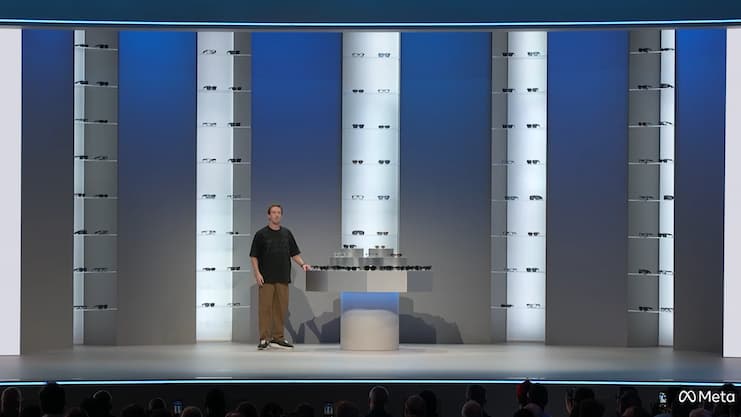
This exaggerated design was a subtle but clever way to underscore one of Meta Connect’s main themes, and that is that Meta is progressively becoming less a software company and more a hardware one.
In the past, Meta attempted to get its foot in the door with Portal smart screens, and before that with the Facebook Phone and a shelved Milan smartwatch. None of these projects gained much traction. The first successful devices were VR headsets such as Oculus Rift (1.5 million units sold), the first Quest (over 1 million units sold), and Oculus Go (over 2 million units sold). As much as critics are right that Meta has not achieved mainstream numbers with any of these devices, the sales were still way above any of its previous hardware attempts. Thus began Meta’s march into the world of physical electronics.
Product Wall
Fast forward to Meta Connect 2026, and the company’s footprint in the XR space is enormous. According to AR Insider, Meta sold almost 1.8 million XR units in Q2 alone. Far ahead of the competition. The VR segment is completely dominated by Meta’s products, with a SteamVR survey showing a 67% ecosystem capture.
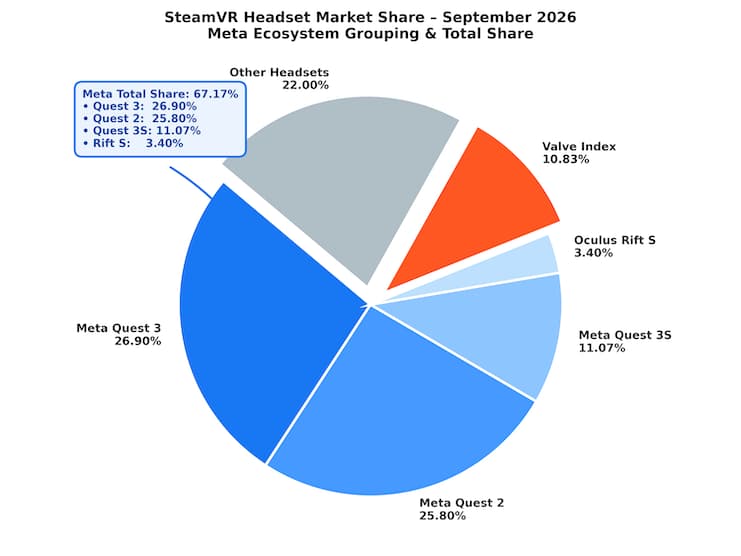
In terms of total lifetime units sold, Treeview puts the numbers at 26.7 million for Quests and 8.9 million for Ray-Ban Metas. The space is crowded with many companies, from Apple to XREAL to ByteDance, working hard to chip away at Meta’s dominance (which, for its part, is increasingly determined to keep its long lead).
The product wall at Connect 2026, proudly extending both horizontally and vertically, was a clear way of communicating that. Instead of focusing on massive expenditures (Reality Labs’ operating loss was $4.62 billion in Q2), Meta decided to focus on results and its branding as an innovator. It wants to be seen as part of the forward-thinking club. Less like TikTok or X, and more like SpaceX, OpenAI, and Anthropic.
New hardware? Nothing to it
This boastful approach carried into product reveals as well. The announcement of Ray-Ban Meta Audio was delivered offhandedly, as if the entire debate around privacy and Ray-Ban Meta creepiness was just some background noise. Rather than address the controversy, Meta dismissed it by simply introducing a new camera-less product.
The reveal of Meta VR Glasses was also carefully crafted. When the moment came, it turned out the device was hiding in plain sight among Ray-Ban Meta smart glasses. The underlying message is that Meta VR Glasses will seamlessly fit in with smart glasses displayed in the back and look just as sleek (notice the absence of the much bulkier Quest 3 and Quest 3S on the product wall). I expect Meta will be reluctant to release Quest 4, codenamed Griffin, until it makes sure it fits on that display shelf as well.
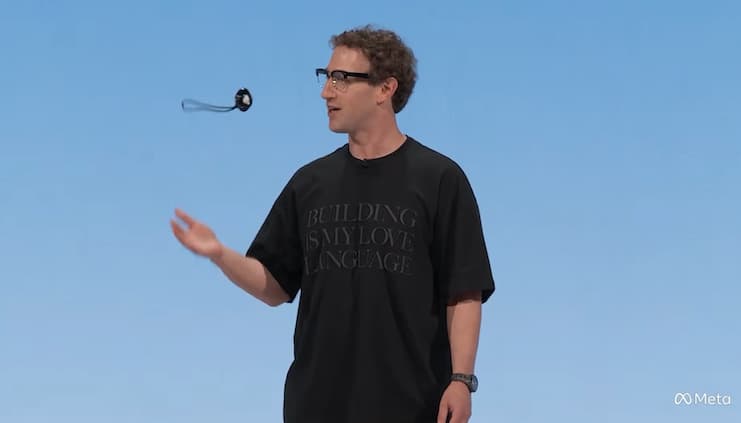
Finally, the reveal of Charm Muse was perhaps the most nonchalant part of the presentation. It was less than two minutes long, with a playful, indifferent energy to it. As if Mark Zuckerberg was teasing everyone with this little gadget and telling people not to worry about it too much because it’s just a keyring.
It’s in Meta’s blood
It would take too much space to list all of the clever tricks and subtle presentation choices at this year’s Meta Connect. The overarching theme, however, was that Meta will continue innovating regardless of broader circumstances and regardless of what critics are saying.
Mark Zuckerberg’s T-shirt stated this matter explicitly. Making new things is part of who he (and, by extension, his company) is. It is a way he expresses his care and an indispensable part of Meta’s identity. Or maybe I am reading too much into it, and he just picked this shirt at random. Somehow I doubt that, though.


Mat Pawluczuk
AR Insider Guest Author