
 by
by 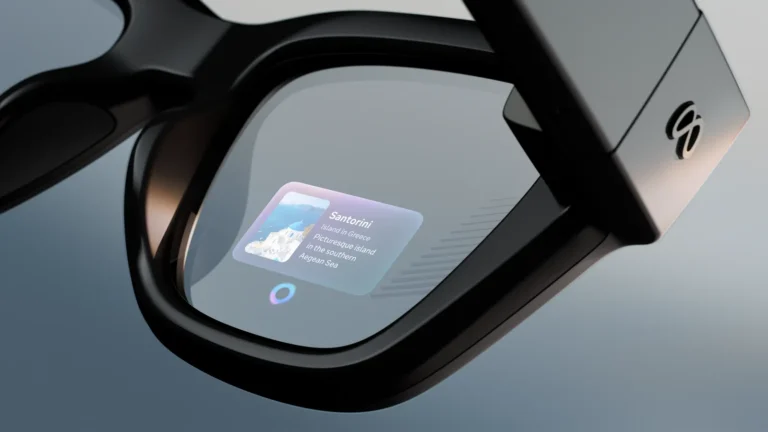
As we roll into 2025, it’s time for our annual ritual of synthesizing the lessons from the past twelve months and formulating the outlook for the next twelve. 2025 was an action-packed year for spatial computing, which continues a gradual uphill ascent toward mainstream traction.
2025 highlights include XR’s ongoing convergence with AI, inflections in non-display AI glasses, the rise of video display glasses, and the unveiling of the long-awaited Meta Ray-Ban Display glasses. Meanwhile, roadmap signals emerged from players ranging from Snap to Apple.
All these approaches – video passthrough AR, optical seethrough AR, and non-display smartglasses – represent form-factor divergence and diversification. That’s a good thing, as XR should include varied formats that are purpose-built and use-case-driven – a key trend in 2025.
Breaking it all down, what were the biggest lessons in 2025? Our research arm ARtillery Intelligence recently tackled this question in its report Spatial Computing: 2025 Lessons, 2026 Outlook. After publishing 2026 predictions here on AR Insider, we shift gears to 2025 lessons.
We’ll break them down weekly, starting here with #1: XR Devices Diverge & Diversify.
Lesson 1: XR Devices Diverge & Diversify
Lesson 2: Practice the Art of the Possible
Lesson 3: AR’s Future is Ambient & Intelligent
Lesson 4: Communications is the Killer App
Lesson 5: VR < AR… But it Isn’t Dead
Spatial Spectrum
As often seen when tech sectors evolve, XR devices are diverging and diversifying. This is a positive step for what we call the spatial spectrum, leading towards devices that are tuned to deliberate use cases and personas. Think of the continuum of PCs/laptops/tablets/phones.
Put another way, the spatial spectrum is no longer a field characterized by Magic Leap, Microsoft HoloLens, and a few others. In fairness, those devices were faced with a dilemma. With a limited XR market size, they had to maximize demand by stuffing in as many features as possible.
But that practice led to a ‘jack-of-all trades, master-of-none’ dynamic that limited device utility to any one user, engaged in a specific use case. These devices offered breadth but lacked depth, which will be the outcome for any all-in-one XR device that continues to be prophesied.
Expanding on that last part, an ongoing hot take in the world of XR punditry is that we’re moving towards a device that will do everything – from high field-of-view immersive entertainment, to all-day wearability and utility. We disagree, as history tells us that formats diverge, not converge.
The divergence we’re seeing today meanwhile breeds focus. That engenders devices that find greater market traction. For example, video display glasses from VITURE and Xreal do one thing well – large private virtual displays for 2D (and, increasingly, 3D) games and entertainment.
Though focused, that use case isn’t “narrow” in terms of addressable market, as it appeals to a large consumer market. And it doesn’t require a native content ecosystem, as it builds on existing devices (smartphones, PCs & consoles), extensive 2D content libraries, and streaming apps.
Market Validated
Another example is non-display AI glasses such as Ray-Ban Meta Smartglasses. These sidestep the bulk, heat, and cost of visually-rich AR glasses for a more toned-down, but elegantly designed, UX. They do more with less, and align with today’s demand levels for tech on one’s face.
Ray-Ban Metas also perform a focused set of tasks with precision, such as first-person media capture, communications, and multimodal AI. The latter has come along at the right time to elevate “lite AR” by taking the burden off visuals – and all their design challenges – as an AR selling point.
And back to the theme of market size, Ray-Ban Metas’ balance of style and tech has been validated – to the tune of 5 million+ units sold to date, according to the estimates of our research arm. They’ve found the right formula for today’s consumer demand levels for tech on one’s face.
Meanwhile, AR that’s more visually rich is rapidly developing from Meta, Snap, Google, and Apple. The latter looms with roadmap moves around AR glasses, while Android XR could help scale AR by lowering barriers for AR device manufacturers. That could unlock spatial scale in 2026.
And at the UX-rich end of the spatial spectrum – or what we call dimensional AR – Snap will enter the consumer market in 2026. Notably, it will enter its sub-segment uncontested, considering an optical-seethrough (OST) device that performs “full AR” and is built for consumer markets.
Underlying all these players is Qualcomm – aligning itself with device divergence through a range of chipsets that map to the above purpose-built endpoints. Expect this diversification to continue in XR. It started to show itself in 2025 and will only accelerate in 2026 and points ahead.
We’ll pause there and circle back next week with another 2025 lesson. Meanwhile, see the full report, which includes 2026 predictions.