
 by
by 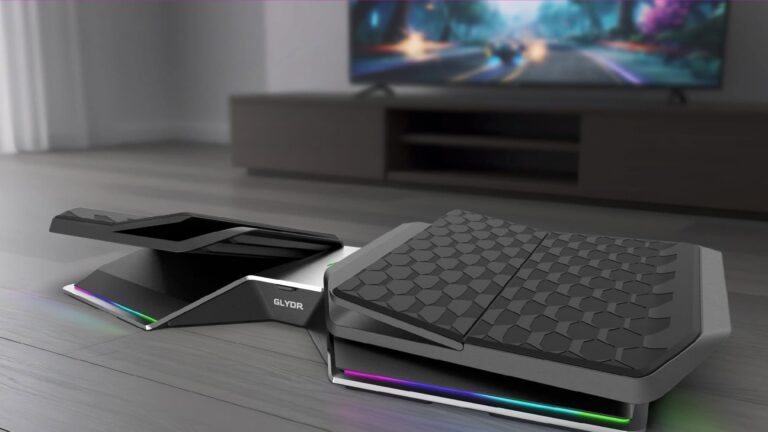

At AWE 2026, I moonwalked in place, steered with tank-style pedals, and tried to kick-start a pair of sneakers, all to see the current state of various locomotion solutions. Below is a quick roundup of my experiences, along with a broader overview of where VR stands in terms of addressing challenges that come with moving through virtual spaces.
1. Freeaim VR Shoes
Made by Freeaim Technologies Limited, the shoes operate by moving users backward in what looks like an infinite moonwalk. This essentially allows the wearer to keep walking forward in both real life and virtual reality. There is also an advanced Pro version that includes sideways motion and sideways correction.
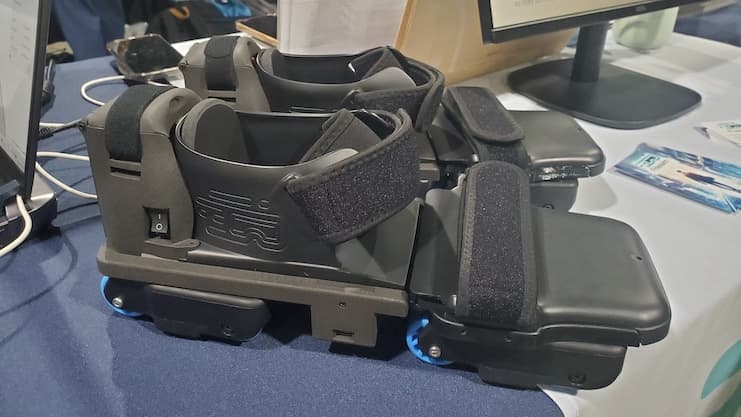
The company comes to AWE almost every year, each time showcasing a new, improved version. What started as a prototype has now evolved into a serious alternative to treadmills and other bulkier setups. Its biggest advantage is the natural walking posture, which stands in contrast to the sliding or shuffling usually required on a VR treadmill.
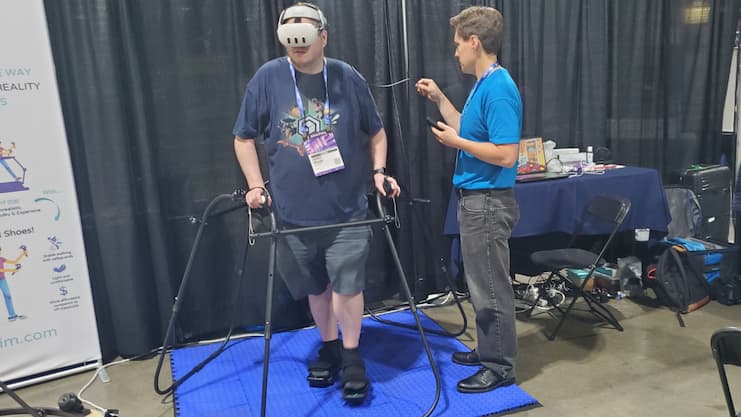
The shoes can be used without a frame, although admittedly that part is full of disclaimers. In the past, when Freeaim was just a one-person booth run by its creator, Ashley Foxcroft, there was no frame. I remember it felt a bit intimidating, especially while in VR and wearing heavy motorized shoes, but I was fine despite having no experience and the product still being an early development kit.
Now, however, with the expansion to LBE, a successful Kickstarter, and a growing user base, the shoes come with a frame by default. This is partially for safety and partially for ease of use. There is an option to enable frameless locomotion, but it requires the Pro version of the shoes as well as completing a 30-minute evaluation program.
There is definitely a learning curve to the shoes, especially for those who want to use them without support. What from the outside looks like a minor loss of balance can feel a lot more jarring to the person wearing them, especially when they are in VR. For example, if the shoes stop abruptly, the sensation is similar to falling backward, which can be unnerving even if you do not really fall. Pacing and turning also require practice. In this sense, the frame can also be used as a practice tool, allowing users to master the shoes before going frameless. Either way, the frame solves many issues but also takes away some important advantages of the Freeaim VR Shoes, namely their small size and relatively low setup friction. The Pro version currently costs $1,780.
2. Glydr
Glydr is a foot controller fitted with two pedals that rest in a neutral position and tilt forward or back. There is also a flap on each pedal acting as a big button.
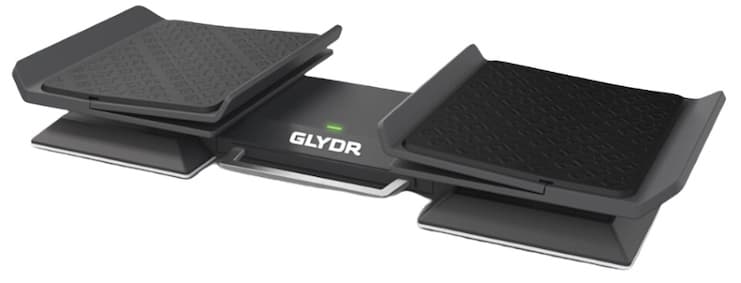
The locomotion mechanics are somewhat similar to those of a hoverboard or tank. Pressing both pedals results in motion, whereas pressing only one results in turning. Visually, Glydr also leans into this analogy. The controller does look like a blend of a hoverboard and a gaming device.
Despite Glydr being different from traditional gamepads, the control scheme is quite intuitive, and the learning curve not too steep. In my case, I picked it up in five minutes. Glydr is marketed as a general peripheral that is compatible not just with XR but also with traditional gaming and mobile. It can be used for button mapping or scrolling, but in VR it is mostly designed to support locomotion.
Currently, Glydr does not support a wireless connection. The company’s CTO, Rick Tett, promises this will change in the future, but for now, this means Glydr needs to be connected to a PC (PCVR) and will not work with any standalone headset.
Using feet to control movement instead of a gamepad can help curb simulation sickness, but Glydr is still very much an abstract locomotion system. Therefore, if someone is prone to discomfort in VR, they will probably feel queasy using the controller as well. The fact that the controller has to be stationary and will not work with swivel chairs can add to that. Glydr, however, does not claim to compete with treadmills or to solve simulation sickness. Its ambitions are smaller. It aims to provide a locomotion mechanic that frees players’ hands and feels more natural and immersive. The $299 price also reflects that.
3. Foottroller
Invented by Tony Tian, Foottroller is a Bluetooth-connected pair of slip-on sneakers that sense the movement of your feet and translate it into virtual locomotion.
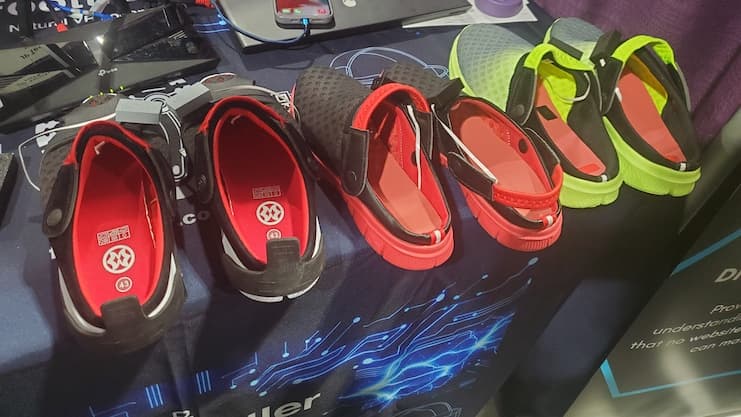
The movement is produced by lifting your feet up and down, as if walking in place. The pace at which this is done will determine the speed of movement in VR. Thus, jogging in place will result in correspondingly faster locomotion. The shoes can also detect jumping when both feet are off the ground.
At least in theory. In practice, Foottroller in its current state is, unfortunately, pretty much unusable. To begin with, two fully charged Bluetooth modules have to be fitted onto the sneakers and then calibrated, creating a significant amount of friction just to get the controllers running. But more importantly, locomoting itself is very unintuitive. To start the movement, the user has to stand on the toes of their right foot and then quickly lift both feet off the ground. After that, they have to immediately start walking in place, or the entire motion will not register. The sequence is time-sensitive, making the experience more frustrating than helpful.
Foottroller suffers from many other (but related) issues. Movement speed does not seem to change the way the promotional materials suggest. Even stopping is unintuitive, as it requires the user to go through the whole kick-starting sequence again. Suffice it to say, even as a developer kit, Foottroller is far from functional.
The idea of walking in place as a way to mitigate simulation sickness is a viable concept, but for now it seems the Foottroller creator has run into some hardware and software issues that have yet to be solved. The price is $99 ($79 for the special edition).
Mat Pawluczuk
AR Insider Guest Author