
 by
by 
Disclosure: Qualcomm invited us to Snapdragon Summit 2026. All experiences were hosted, but no additional compensation was received.
A driving principle in Qualcomm’s endeavors to prime the agentic age is what it calls personal AI. This initiative sits at the center of a world in which users’ many devices – phones, watches, glasses, etc. – ingest contextual and permissioned data that empower agents to do their thing.
This also aligns with a theme, underscored throughout Snapdragon Summit, around the evolution towards agentic AI. We’re currently in the age of apps, transitioning into the age of assistants. The latter is mostly defined by prompting AI engines to execute one-off tasks and answers.
Agentic AI will take the next step in achieving end goals by executing multi-step workflows in the background. For example, meeting someone for dinner requires several apps. Agents replace those apps with one touchpoint that works towards a goal, doing all the app work for you.
Back to personal AI, the above endpoints require AI agents to not only be given a goal but to execute it in the right context, says Ziad Asghar, Qualcomm’s SVP and GM of XR, Wearables, and Personal AI. That context is formulated through an opted-in and encrypted profile of you.
For example, AI agents will know your food allergies when selecting restaurants; or the fact that you have two kids, a dog, live in suburban Los Angeles, and are a craft beer connoisseur. That and other key signals will be ingested and processed through a constellation of devices.
Working Smart
So how does this all get enabled and unlocked at the chip level? Qualcomm’s chipsets are incorporating all the above capabilities into their architecture by running models directly on silicon, closer to their NPU brainpower, and tuned for compute-efficient processes.
One key principle in doing this is that it’s about working smart as opposed to working hard. In other words, we don’t necessarily need more compute, says Asghar, but rather more efficient and coordinated processing. For Qualcomm, that plays out in its SoC design.
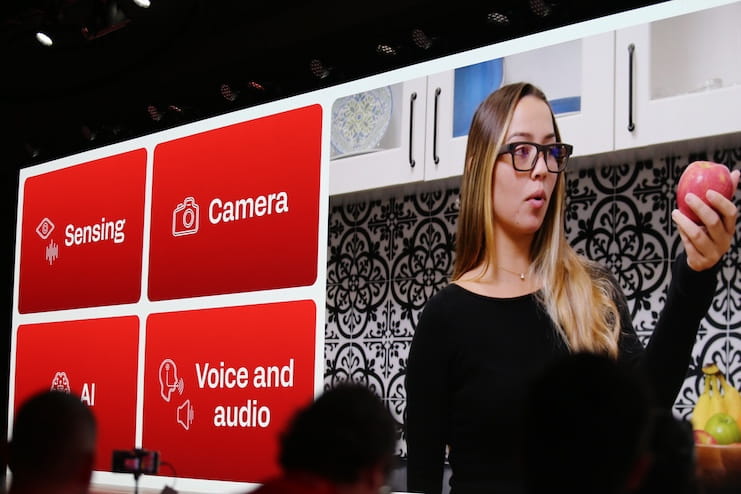
For example, key functions need to be tuned, optimized, and coordinated. They include smart sensing (voice, visual, touch, and gestural), shared memory, neural processing, and connectivity, to name a few. These are the spinning plates Qualcomm synchronizes in its SoCs.
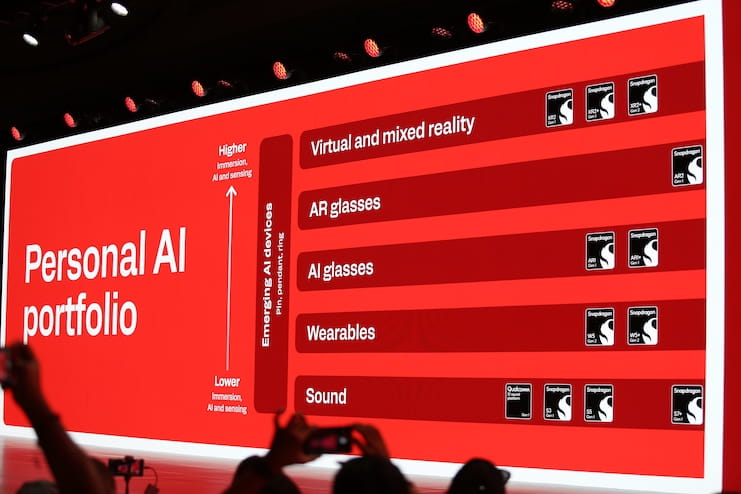
And they take shape in purpose-built chips that collectively represent the personal AI initiative. For example, Wear Elite powers wearables and their nuances. Reality Elite is tuned for spatial rendering in XR devices, while the AR series (e.g., AR1+ gen 1) powers AR and AI glasses.
The latest addition to this continuum was announced today: Sound Elite, Gen 2. It will drive the most natural input in the personal AI constellation: voice. This includes input capabilities, neural processing, and output, which elevate audio devices like wireless earbuds.
In on the Action
To color all the above with real-life examples, Qualcomm has been busy across the personal AI universe, including its endpoints in XR. For example, it powers the new Snap Specs (see our review). It hasn’t disclosed the architecture, but it could be a dual-SoC design, like Specs Gen 5.
Elsewhere in the spatial spectrum, Snapdragon AR1+ Gen 1 is at the heart of much-anticipated AI glasses releasing later this year from Warby Parker and Gentle Monster. In collaboration with Samsung and Google (Android XR), they’ll compete with Ray-Ban Meta Smartglasses.
This incorporates Google’s endeavors in what it calls intelligent eyewear. Positioning Gemini at eye and ear level, it’s all about situational intelligence such as navigation, object recognition, and world annotation. It will also tap into Android mobile apps for expansive functionality.
Meanwhile, Samsung Galaxy XR is fueled by Snapdragon Reality Elite. And outside of the XR universe, Snapdragon Wear Elite works in tandem with Google’s Wear OS to bring smartwatches like the Pixel Watch 5 into the personal AI fold. There, it will work alongside Gemini Intelligence.
Beyond these integrations, Qualcomm will begin to scale its OEM collaborations with the START program. As we’ve examined, this will lower friction and barriers to entry – starting with AI glasses – so that eyewear manufacturers and fashion brands can get in on the action.

Surface Area
Stepping back, Qualcomm has been positioning itself for this moment for years. Its traditional stronghold has been smartphones – especially in the Android universe. But over the past decade, smartphone growth has decelerated as the device approaches global saturation.
Combine that with the fact that Apple started making its own chips, and Qualcomm saw the writing on the wall. It actively started to redefine and diversify itself, blitzing the world of devices that sit outside of smartphones, while simultaneously growing its smartphone business.
Whether intentional or unintentional, that positioning now puts Qualcomm in a prime position to achieve its personal AI vision. That’s simply because the user touchpoints across all of those constellation devices give Qualcomm greater surface area to ingest contextual data.
Not only does that positioning offer key ingredients for personalized and eventually-agentic AI (inputs), but the same user touchpoints are where the AI actions are executed (outputs). And the more devices it powers, the more effective it can be in its personal-AI execution.
In other words, operating across devices offers economies of scale in compute terms. It can load-balance memory and other resources across devices. This systemic approach creates a sort of hive mind of efficient compute processes. And that especially aligns with Qualcomm’s DNA.
Editor’s note: AR Insider was able to record a video interview with Asghar following his keynote. Offering more color on all the above, we’ll publish that shortly, and under separate cover.