
 by
by 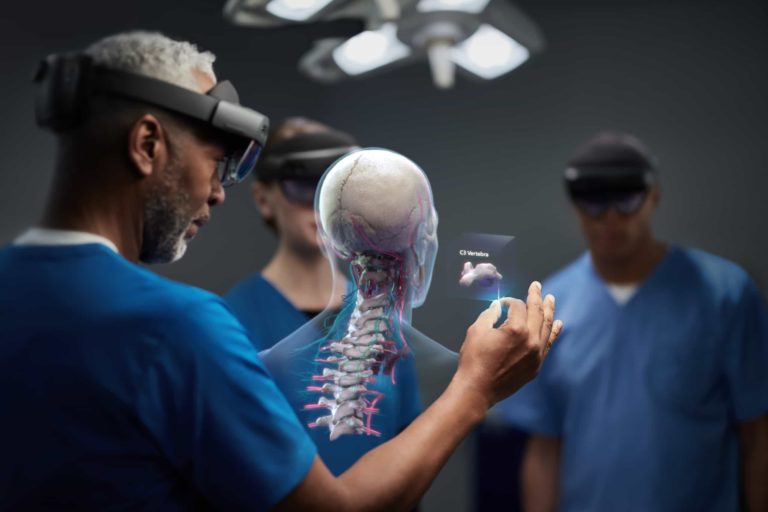

Among AR’s subsets, use cases, and areas of evolution, enterprise training continues to gain traction. This is noteworthy because AR’s spatial cousin, VR, is known more for its application to immersive learning and training. AR’s advantages include better situational awareness and real-world presence, which prime it for a broad base of enterprise settings and job functions.
For example, line-of-sight instructions for industrial assembly or maintenance can be used for training and developing competency. This goes beyond training and can also be used in live workplace productivity. In either case, visual and hands-on learning boosts memory recall, skills development, end-user confidence, and productivity gains.
But how are these principles materializing today? Here are a few examples.
Hands-On Healthcare
Many medical textbooks feature highly detailed illustrations that serve as valuable reference points for people training for health care roles. Books will remain useful, but some facilities make education more interactive with AR.
One health system uses the technology to train its fellows, medical students, and residents. They can then manipulate and visualize 3D objects that appear in the room. AR learning experience lets students see inside the intracranial cavity to check an implant’s position.
The technology also provides pre-surgery education for patients, helping them understand the steps and intended outcomes. It similarly educates surgeons before operations, assisting with planning and helping them accommodate hidden bone and vascular structures.
Case Study: Fujitsu Streamlines Assembly and Training with AR
See What I See
Educational coordinators may have workers complete training independently, such as going through online modules. See-what-I-see remote assistance opens the door to interactive supervision, even when the trainers are in different locations.
One example comes from the packaging industry, where a trainer connected a projection screen to their laptop and selected the appropriate program files to run an interactive AR experience for a student elsewhere. That student donned an AR headset and remotely linked it to the trainer’s system, allowing them to hear real-time instructions. The learner then inspected a 55-gallon steel drum lid with calipers for quality control while the educator watched.
Some AR platforms offer real-time experiences and store recorded sessions. They support skill transfers and knowledge retention by allowing people to get real-time feedback or repeatedly watch experts perform specific tasks. AR is a highly accessible technology that people can often use without headsets. It delivers partially immersive experiences that promote learning while keeping users aware of their surroundings. That characteristic makes it popular in environments with machinery or hazardous features.
Case Study: GE Aerospace Meets the Moment with Immersive Training
Tracking & Training
Many employee education modules teach the correct movements. They improve workers’ safety and productivity, whether they are lifting heavy boxes or using metal detectors to check attendees entering event venues.
AR applications may include motion-tracking, such as eye tracking, to check learners’ engagement and interaction levels. That data gives educators and software developers details about which content grabs learners’ attention or holds their interest longer than usual.
Researchers have developed an AR education application that encourages students to maintain the proper posture while picking up suitcases. They receive prompts and visual guides as immediate and constructive feedback. They are then less likely to develop bad habits that could cause muscle strain or instability.
Quality of Work Life
Speaking of strain, it’s also easy to envision additional applications that help workers develop techniques for remaining comfortable in strenuous jobs. Chefs, police officers, and road construction workers are among the many employees who may stand for many consecutive hours. AR training modules could teach them positioning suggestions, stretches, or movements to make their roles more manageable. This can mean less physical strain or cognitive load in their day-to-day work.
And this brings up AR’s most underrated benefit. Beyond productivity gains that excite the C-suite, it can engender quality-of-life benefits for end users. When this factor isn’t in place – or when it’s not adequately communicated during internal deployments – AR programs can quickly fail, or fall into the dreaded “pilot purgatory.”
Exploring Effective Workforce Training
These examples highlight a few of the many possibilities for AR training within modern workforces. Decision-makers can optimize outcomes by finding solutions tailored to specific industries or settings. Immersive technologies will continue to enhance how participants gain skills and become familiar with the circumstances they are likely to encounter in their work, so now is an excellent time for leaders to research options and consider implementing them.
 April Miller is a senior writer at ReHack Magazine and editorial contributor at AR Insider. She specializes in VR/AR, IoT, and business technology. See her work here and follow her @rehackmagazine.