
 by
by 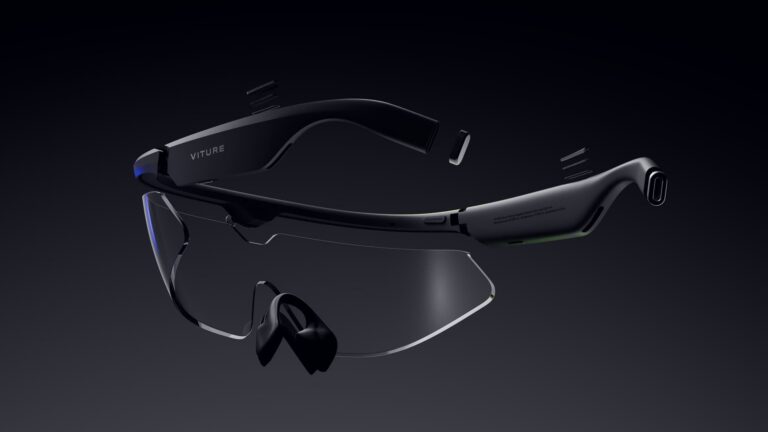
Viture has propelled the momentous video display glasses category. These offer virtual screens to mirror one’s devices for private and high-fidelity entertainment and gaming. It’s a simple but compelling way to elevate users’ existing media libraries and streaming apps.
These low-friction attributes have made video display glasses reach well beyond the limited market size of XR glasses. VITURE continues to develop adjacent use cases to expand the addressable market further, such as enterprise productivity via virtual screen-based workspaces.
Now it’s going deeper into enterprise XR with Helix. Launched in partnership with Nvidia, these workplace safety and productivity glasses see what the wearer sees and provide situational intelligence. We’re talking everything from industrial assembly to intricate clinical lab work.
VITURE categorizes these use cases under the banner of “AI-assisted workflows.” And it does its thing by streaming the user’s first-person perspective to a multimodal AI engine. Visual and voice inputs are matched with audio outputs (hence multimodal) for situational intelligence.
AI-Assisted Workflows
The result is that users can get coached through various workflows. These can be simple, repetitive tasks – a common use case for enterprise AR – as well as dynamic and non-repetitive scenarios. VITURE says that the latter is all about being able to see and reason with the world.
That last part is where the value stacks up, and where Nvidia plays a big part. Specifically, Helix integrates NVIDIA’s XR processing capabilities. And from a hardware perspective, inputs are enabled by Helix’s 12 megapixel first-person cameras and a four-microphone array.
Here at AWE, we had a chance to take a Helix working prototype for a test drive in a simulated clinical lab experience. Using visual recognition – in this case, chemical-filled test tubes – it guided us through a sequence of processing the contained materials through a centrifuge.
But it wasn’t just an “on-rails” guided workflow, as users can ask open-ended questions. In some ways, this takes the place of the classic remote-assistance use case.” Remote see-what-I-see experts can be replaced or reserved for situations that are elevated, thus covering more ground.
Origin Story
In fairness, this isn’t VITURE’s first collaboration with NVIDIA. As we’ve examined, it has worked with the chip giant and AI leader at the Le Cong Lab at Stanford University and the Mengdi Wang Lab at Princeton University. This prior work was the origin of Helix’s focus in clinical settings.
This is fitting, as lab work checks many of the boxes for enterprise XR applicability. The technology can reduce human error and cognitive load for operators. That makes it not only resonate with executives in charge, but with end users who can lessen their job strain.
That last part is key, as failure to win over end-users is a debilitating barrier for enterprise XR deployments. If front-line users, such as lab technicians in this case, don’t see personal advantage, enterprise XR deployments tend to fall flat or get stuck in the dreaded pilot purgatory.
As for availability and rollout, Helix will cost $600 and is scheduled to release in Q1 2027, with reservations starting today. We’ll be waiting for that day to see if all the above advantages are realized in the open market. Meanwhile, expect continued expansion and evolution from VITURE.